Showing posts with label University of Minnesota. Show all posts

Tuesday, January 23, 2007

All right Senior Thesis: Game On

I touched on this topic at the beginning of the New Year, but here are some thoughts that have materialized in the past few days with my Senior Thesis Writing Seminar:

Possible Topics:
From Blog Photos

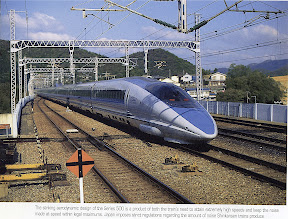
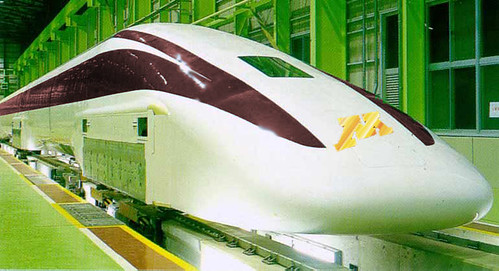
Too often I have used European examples of High Speed Rail; Not this time, the above image is of the Nozomi Series 500 Shinkansen in Japan from Bullet Trains. According to sources on Wikipedia, The Nozomi can reach speeds of 320km or 200 MPH, but is currently only operating at a maximum of 300 km or 186 MPH.

1) The Need for High Speed Rail (HSR) in the Midwest.
The idea came to me while I was on Study Abroad participating in the Scandinavia Urban Studies Term (SUST) through HECUA last semester. It was very easy and reasonably priced to get on a long-haul train and go from Oslo-to-Bergen in roughly 6 hours. At the end of my term, I attended a conference on the development of High Speed Rail (HSR) corridors in Norway that included High Speed proposals with service from Oslo-to-Trondheim and Oslo-to-Bergen.
This got me curious as to why the United States did not have a High Speed Rail network and what was being done in the field. Over break I began reading a few sources, particularly High Speed Rail Policy for the 21st Century by Anthony Pearl and read over the 2004 Executive Report of the Midwest Regional Rail System
My paper would be similar to these sources of looking at European HSR applications and then determining policy solutions, amounts of financing and sources of financing, as well as feasibility for applications in the Midwest to connect to HSR networks pre-existing predominantly in the Northeast corridors (Acela, formerly the Metroliner).
From Blog Photos
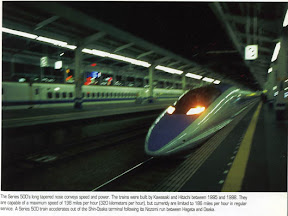
Another picture of the Nozomi 500 Series Shinkensen

2) I-494 Transitway Study
This topic would directly relate to my internship at the State Capitol with Rep. Ann Lenczewski and is a topic that is directly related to the Twin Cities MSA and the South Metro. This would be a preliminary model study of transit options for the I-494 Corridor including: BRT, LRT, and possibly PRT. This study would then be used to inform Rep. Ann Lenczewski to propose legislation for funding of a true study conducted by the Metropolitan Council.
Through my internship I will have contact with major stakeholders involved in the study. However, since there has been no formal study of transit along I-494, it may be difficult to find sources directly related to this topic.

And yet another question, which of these topics would you choose, and which one in your opinion would help Minnesota and the Midwest the most?
Whichever way it goes it should be a fun semester and a interesting senior thesis. Wish me luck.

Tuesday, March 28, 2006

I GOT PUBLISHED!!!

...In the Minnesota Daily, the student paper of the University of Minnesota. Check it out at the Daily's site.
Or you can read it here too...

University priorities
In the Friday Daily, there was an editorial, “Prioritizing transportation,” stating that the proposed Central Corridor light-rail line would benefit the University more than a University football stadium that has been proposed on the site of the Huron Boulevard Parking Complex. Although I agree with the author that the University and its students will benefit from the Central Corridor project, we do not need to give up a new stadium to get the project done.
In the editorial, the author states that the University has a seat on the planning committee for the Central Corridor. While the University is a major stakeholder affected by the project, this does not mean that the University can afford to put financial backing toward the project. State, federal, county and city resources can be used for this purpose, however it takes political capital to commit to the project.
I do agree with the author that the University should use its political power to stand with local transit advocates and state legislators to support the project. In the March 22 Pioneer Press, there was an article stating that the Federal Transit Administration approved the cost-effectiveness analysis of the Central Corridor. The next steps in the process will be the public commentary of the draft environmental impact statement. I suggest University students attend and state their opinions.
Light-rail transportation on the Central Corridor will benefit University students and employees, but so will a new football stadium. The stadium will add to the quality of life on campus, encourage the trend of students living on campus and bring a stable source of funding to University athletics.
At most universities, revenue from football pays for the cost of the football program and all the nonrevenue sports programs. A new stadium will help us fund these athletic programs. The stadium and the Central Corridor project are actually complementary. Events at the stadium will encourage use of corridor transit, and the availability of transit to the stadium will reduce the congestion associated with stadium events. We can and should have both a stadium and light rail.
Andrew Wambach University urban studies undergraduate

Thursday, March 09, 2006

Maglev Trains + University of Minnesota = Bye Bye Campus Connectors

Way back in October, I wrote about my dreams of having a Maglev Train operating between the St. Paul Campus and the East Bank Campus ending near or around Stadium Village. To read the old post click here.

Recently there has been a lot of controversy about the Central Corridor and the University of Minnesota in regards to its alignment through Campus. There has also been controversy between the University On-Campus Stadium and the Station 19 Architecture Firm located in the Historical Landmark fire station off of Oak St. and University Avenue SE. To read the Star Tribune article click here.


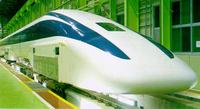
Goldy's Rapid Express, Complete with Maroon and Gold Paint Job and University of Minnesota Emblem. Even Maglev Trains love Maroon and Gold...

The train could operate along the existing U of M Transitway, and then go underground beneath the University of Minnesota Stadium and have a station with direct access to the concourses for public seating as well as access to Suites. Or the train could remain on the surface, but then tunnel under Oak Street and connect with the Central Corridor Light Rail underground station (if it ever gets built). Students could then connect to the Central Corridor LRT and have access to the West Bank of the University of Minnesota and the Campus Connectors could be eliminated completely. Buses could be sold to Metro Transit, but still keep their Maroon and Gold paint jobs, heck even one can be given to the Minnesota Historical Society.

In the Minnesota Daily, there was an article about the Regents and the coming agendas facing them. One in particular is the Central Corridor. In the article, there is more talk about using University funds to build god awful monuments to faculty, this time a giant wall, with formulas and theories written by University Faculty. The Scholars Walk is nice, but has taken a really long time to be completed. Meanwhile, the Stadium is still in talks with the Minnesota Legislature, and the University won’t be able to have any decision making powers on the Central Corridor Tunnel. I suggest to the Regents that they try to negotiate with the Metropolitan Council and MNDOT to allow students in the schools of Architecture, Urban Studies, and Civil Engineering to work with these stake holders in designing the underground stations of the LRT, maybe even the stations above ground as well.

While searching through the archives of the Minnesota Daily I found an article from about 4 years ago, where then President Yudof suggested using students in the school of Architecture to help design University buildings instead of hiring high priced firms. Why not do the same with Public Infrastructure such as LRT stations? This way, the University can activly participate with the project. In addition, the students could improve the current bus shelters, by having heating vents in the ground in bus shelters and not from heating lamps above. Sometimes I wonder about people who designed those bus shelters and LRT stations and where they got their degrees from. Don't they know that warm air rises so its really not a good idea to have heating lamps as a way of keeping people warm in the winter months. Also, the University of Minnesota should stand with Transit Advocates such as Transit for Livable Communities and encourage lawmakers to find a dedicated source of transportation funding.

I think it would be really sweet if the Maglev Train operating through Campus could become a reality, but maybe the buses will be what we have for the rest of our days. Plus, by the time all of this stuff is said and done, I will be long gone from the University. But it never hurts to dream. I have heard support for this project from others and I hope support continues to grow.
Let’s go Maglev and Light Rail. Trains may not be the “magic bullet” solution for all of our urban problems, but they can help reduce our dependence on the automobile and create a better urban form.

Think it over, and tell me what you think blogosphere readers.

Andrew

Wednesday, February 15, 2006

Central Corridor…No tunnel, No Train


Ah the Central Corridor, the Twin Cities second light rail line that may never be. This line has been the topic of many discussions in the world of transit advocacy and in the local papers including the Minnesota Daily

The Columnist for the Minnesota Daily, Angela Gray, must have attended the Transit Summit at St. Thomas before writing the article. I was impressed on how she interviewed some important figures of the Central Corridor Partnership and business owners located in the corridor. She even interviewed students around campus to see if they would support a light rail line going through campus. However, the student that she interviewed stated that a tunnel would not be crucial and that "students will adapt". I highly disagree.

A few weeks before the article in the daily was published, there was an article in the Star Tribune on Planning Officials, The University of Minnesota, and the controversial tunnel. A local blogger has commented on this issue as well. He has the story linked in his post. I suggest you read it.

Some crucial information left out in both of these articles has been the cost. They skimmed the surface of the cost of the project in Grays article of the project being around $800 Million, when really the project is closer to $900 Million. The project total cost in 2003 dollars was about $840 Million. The Metropolitan Council hopes that it can cut the cost by eliminating the tunnel underneath Washington Avenue. The figure is an estimated $140 Million. I assume most of the cost of tunneling would be the engineering improvements necessary to turn the Washington Avenue Bridge into a triple-decked bridge with Pedestrian on top, Traffic in the middle, and light rail on the third rung.

Without the tunnel, the light rail will be forced to run on the surface, eliminating two lanes of traffic on each side of Washington Avenue simply because it is not wide enough to support central median operation, parking, sidewalks, and two lanes of traffic. This is Washington Avenue, not University that is 120 ft. in width.

I wish planners had more foresight than 25 years. They should be planning for one hundred years. Then again, with the way cities change and re-arrange themselves it is difficult to see what changes in technology and the built environment will occur over the years.

Last week, while enjoying a conversation with a friend of mine at Royal, I got into a discussion with someone sitting behind me about how backwards the current University alignment is. He tried to sell to me that the line should be located 2 blocks North of University Avenue. He also tried to sell to me that we needed more vertical economic development, basically transit villages with very large multi-block “sky-cities”.

I had two major disagreements with his proposal. The first was the location. 2 blocks north of University Avenue is where the Red Rock/Northstar connection is planning on running on the freight ROW. The second is the cost. A proposal that includes such large planned development like a transit village would put the total cost probably into the Billions. Although I agree that development like a “sky-city” would be awesome for the Twin Cities, right now with all the space we have available there is no pressure for land conservation and thus development like this is seen as overkill. For those interested in these types of development I suggest viewing Discovery Channel’s series Extreme Engineering.

Last issue to write about is the controversy of the intersection of University and Snelling Avenues. I agree with the author of twin city sidewalks, that the light rail may need to be elevated over this intersection like the Lake St. station which would be cool or be put underground which is pretty unlikely. I think an elevated station would be the best bet. As for the owner of the Midway Bookstore, I hope his store is where the first plank goes for the station. Just think, had he supported the rail he probably would have gotten a much better facility and benefited from a more walk-able University Avenue.

Back to my original topic, this Tunnel is crucial. If the tunnel is not in place, it will add more congestion and suck up tax dollars just as Republicans say it will. Let’s not let this happen. I encourage all members of the University of Minnesota to encourage planners and the powers that be, that the Central Corridor has to have a tunnel or needs to be put on the shelf until other rail projects such as Northstar are completed.

Whew, a pretty lengthy post…ENJOY!!!!

Andrew

Saturday, October 01, 2005

Zoom Zoom Zoom, not in a Mazda, But in a freakin’ fast train!!

All right, for all of you readers who complained about the CC post, this will be one of my last entries on Transportation Issues in the Twin Cities. On a side note, it is my Major here at the University and if you don’t like it don’t read it. It’s as simple as that.

Over the Summer, I was working at Minnetex over on the West Bank of the University of Minnesota. I would get up in the morning and ride my bike along the transitway between St. Paul campus and East Bank; then make my way to Wiley Hall. The ride was about 5 miles from the house on Lindig to the West Bank and took me about twenty-five minutes to a half hour to get to work.

As I was riding, I noticed the existing rail infrastructure that ran parallel to the transitway and into the big industrial complex near the Huron lots. I also noticed the seldom Campus Connector that would run past from time to time. It was Summer and the busses weren’t running as often as they do during the school year. The rails were often empty, except for the occasional large freight train burling down the tracks at top speed, and another morning I was up early enough to cross over the tracks and see an Amtrak passenger train making its way towards St. Paul.

One particular morning it was raining really hard, and I had slept in so I was already late for work and had missed the Campus Connector at Gortner. As I am riding I am thinking to myself, “This really sucks, why did I sleep in? I swore my alarm clock went off, and on top of that I have to ride in the rain!! I wish there was a faster way to get where I am going.” And then it came to me. One of the craziest ideas I had of the summer, building a Maglev line between the St. Paul campus and the East Bank.


Maglev Train

Maglev stands for Magnetic Levitation and is a transportation technology involving the use of magnets to propel passenger trains at higher speeds than existing rail technology. There are test guideways in Germany and in other countries and China has already developed some lines that use this technology. We discussed this technology in my Fundamentals of Transit Planning class last semester. My professor had been to the test track in Germany and had a chance to ride on it. Speeds could be reached of upwards of 256 Miles per hour, but where not tried any higher due to the length of the guideway.

There are some disadvantages associated with Maglev. The first and most important is the cost of building and maintaining the guideway that maglev runs on. Maglev runs similarly to a monorail type of track, no rails, often just concrete with lots and lots of magnets and sensors built into them. This is why the technology is not as popular as it could be. Most of the world still has a ton of regular rail infrastructure that can be upgraded for the use of High Speed passenger trains as has been done in most of Europe and Asia, but not here in the United States. The cost of building the new guideway is often what kills the enthusiasm for the project.

However, if the University of Minnesota and specifically the Center for Transportation Studies where to try and get a test track similar to the one in Germany , we may be able to get some of the cost of the guideway paid for by the Federal Government. I know a lot of students would rather see a stadium ( I want one of those too) or reduced tuition (me too as well), but imagine for a second, getting on a train at the newly completed Gophers stadium after a Gopher victory, and being “zoomed” over to the St. Paul Campus in under 7 minutes!!! Same with people who have live on St. Paul campus or near the St. Paul campus (as I do), they could get themselves to the St. Paul Student Center and then take the train to the East Bank. The system could later be extended to the West Bank, and could initially connect the State Fair grounds as well and limit the number of buses coming from the Huron lots.

I don’t know about the rest of you, but the idea of getting on a train and being able to travel from the St. Paul campus to the East Bank in under 7 minutes compared to the bus system (which is great I admit) that takes 15 minutes to a half hour, will sound awful nice come December.

In the meantime, see you on the bus!!

Andrew