Showing posts with label High Speed Rail. Show all posts

Wednesday, December 03, 2008

Lot’s to think about without telling you what to think!

November 20, 2008
-Thanks to Gary Eichten for the title of this post. The past 6 months I have been listening to a lot of Minnesota Public Radio (MPR) and National Public Radio (NPR) on my commute to Lakeville in the early morning hours. I always liked their tag-line of “Get out of the car smarter than when you got in”, but lately with all the economic turmoil you end up getting out of the car more frustrated than when you finished reading the Star Tribune. But more about politics, including my thoughts on the election, energy, and the economy later in the blog.

Currently I am in lay-off from Northern Pipeline Construction Company (NPLCC), reflecting upon the season and trying to think of how I should prepare for my next move. Oh Possibilities!! I wish I had someone to tell me what to think/do especially with the bad news on the table about the economy and the ever-looming threat of Unemployment reaching 8 or 9%.

About a month ago my brother Frank and I were talking about my season at NPL, while working on his basement. For example, the major themes I learned and challenges that I was encountering. Before answering him on what I learned, I paused, and then looked him right in the eye and said, “Wow Andrew, you really can’t tie Knots!!” We both erupted laughing and I went into my usual “Oh poor me” routine of which I am famous for. It has been a steep learning curve, diving straight into the deep end of construction, and being “Greener” than grass. Honestly it (Inability to tie simple knots) has been the most frustrating part of the job and something that I will have to dedicate time to in the off-season if I want to continue/survive another season.

The construction industry certainly has agreed with my body. Since leaving my last job seven months ago, I’ve lost over 30 pounds through sheer work and am almost back down to my weight in High School of 180 pounds. It also agrees with me in regards to satisfaction. To see the end result of a days, weeks, or months worth of work and what we accomplished; as opposed to advocating for something that may never come; such as my obsession with bringing High Speed Rail (HSR) to the Upper Midwest.
-A quick side-note on HSR. The California High Speed Rail bond measure on this Historic election season successfully passed!! It may take five to ten years for the results to trickle over to the Midwest, but hopefully California’s investment will have benefits for the rest of the country. As I stated on a message board on election night about this topic, “This is an issue where “Left Coast” envy can potentially be a great benefit”. I am fully willing to let California run quarterback on bringing rail renewal, just please, please, please don’t blow it. A great blogger, Robert Cruickshanks, has done a great job championing this issue, posting almost daily updates right up to the election. Those interested should link over and scroll through his posts.


Typing from the cold Northwoods of Minnesota, just sitting by a lake (Small nod to John Pryne) I find myself in the usual predicament. It seems that every six to seven months I am tired of whatever it is that I am doing and ready for a change. While I am able to find employment in that time period; there isn’t something that holds my interest or passion, and I (like many people my age and in the working world) face the music of paying the bills or going back to school to further my education to land the “passion” driven job that will keep me satisfied.

Fast forward to where this blog picks up, December 3rd 2008, and I am in my favorite coffee shop: Espresso Royal, typing away and getting set to head over to the West Bank of the University of Minnesota. I am considering revisiting my passion of High Speed Rail (HSR), especially with the recent developments that I alluded to above.

Well enough whining “poor me”, onto some topics I have been meaning to write about…

The Election;

About two years ago, I wrote a post on where I thought development in the Twin Cities would progress; this was before I really knew much about Barrack Obama. I quote the following from that post:

November- 2008: The Bush Presidency is over. Democrats reclaim the White House with anybody but the following: Hillary Clinton, John Kerry, John Edwards, or Joe Lieberman. In a stunning turn of events John McCain is elected and becomes one of the best things to happen to both Republicans/Democrats by being a great moderate President kicking the evangelicals out of the Republican Party and brining in more allies to assist with Iraq.
(Events are fictional, but I really hope they happen.)


In the fall of 2006, while studying abroad in Norway, on-board a train to Sweden; I listened to Barrack Obama’s book: The Audacity of Hope. I found myself nodding along with everything he talked about: Our need to change our politics, our policies from energy to economic, to social and etc. But mostly that as Americans, and as a people there is more that unites us than divides us. Like most Democrats, he became my Candidate and I am very happy he won the Election.

So what’s the point of posting the quote from 2006? John McCain was not the moderate/Maverick that we thought he’d turn out to be. He aligned himself with the Bush policies of the past 8 years, which now W is trying to say is not his fault, Nytimes or Washington Post, and he poorly vetted Sarah Palin for his VP, when someone (admittedly) like “T-Paw” Pawlenty of Minnesota would’ve probably won him more states. Also, Joe Lieberman has become a "independent Democrat"/Republican Hawk

Anyway, I am excited to see what Obama brings as the 44th President of the United States of America.

Onto Energy. There has been a lot of talk about renewable energy and the need for new power sources, reducing and eliminating foreign oil etc. One of the plans that has become quite popular and heavily advertised is the T-Boone Pickens Plan. The Texas Oil Billionaire has spent large amount of his fortune on wind farms in the Texas Pan-Handle and now awaits capitol for Transmission Lines to distribute the power to supposedly 300,000 homes. A similar problem exists in Minnesota; the need for major investment in Transmission lines to distribute power from renewable energy sources such as the large Wind Farms in Southwestern Minnesota. What ties the two together? That both of these plans should incorporate investment in High Speed Rail Infrastructure to carry the power as well as passengers if feasible. That way, the service would be using power from renewable sources, providing new areas for development and redevelopment, and reducing the need for short-haul air travel all at once.

I know I know, enough about the HSR but I had to get it off my chest. :-D

Not much to say about the economy except that we are officially in a Recession and have been for at least a year…Big surprise there I guess. Good deals on HDTV’s if you can afford them, I am hoping to snag one this year if given the opportunity.

Keep your heads up and ears to the ground when it comes to deals.

That’s all I got for now, got to get moving to the West Bank, and I have to walk or take the Campus Connecter because I no longer have a U-Pass :-(

Saturday, May 12, 2007

A few sections from the Thesis

A day away from graduation and completion of my Undergraduate career from the University of Minnesota Twin Cities. I turned this baby in two weeks ago, but have wanted to put up some sections ever since I started, so without further delay, here are a few pieces of the long awaited thesis.

Enjoy.


The Need for High-speed rail in the Midwest


Between January 2005 and January 2006, the federal Department of Transportation recorded 9,805 flights from Minneapolis-St. Paul International Airport (MSP) to O’Hare International Airport in Chicago (ORD), a distance of 334 miles (Bureau of Transportation Statistics, 2007). While air and automobile travel dominate the regional market of the Midwest, an intercity high-speed rail (HSR) service with speeds of 200kmh/125mph or greater could feasibly compete with or substitute for regional air carriers and automobiles in fixed travel corridors with distances of up to 650 kilometers/400 miles or less (Gimpel & Harrison, 1997). This paper describes the reasons for renewed interest in passenger rail in the upper Midwest, the history of passenger rail service in the region, and the plans currently under consideration for implementing high-speed rail in the upper Midwest.


A Point of Crisis

In a speech to the American Association of State Highway and Transportation Officials, Skinner (2000) stated that a major crisis is needed to galvanize the public and force a policy change in transportation. Since 2000, two major crises, the destruction of the World Trade Center by terrorists who hijacked airplanes and Hurricane Katrina, have made our need for new transportation options apparent.
In the closing chapter of his book: New Departures: Rethinking Rail Passenger Policy in the Twenty-First Century, Anthony Perl (2002) described the effects of September 11th, 2001 on the transportation industry. Immediately after the attacks, all air travel in the United States and Canada was grounded in the hope of preventing any further attacks. Many travelers on the East Coast, stranded from grounded flights, rediscovered the nation’s intercity rail system. Perl writes “For the five days following the attacks, Amtrak’s ridership was up 17 percent to around 80,000 passengers” (p. 265). Perl and others have argued that passenger trains have an important role in developing “a more robust, integrated network that can provide redundancy and multiply the available mobility options” and to not just be a fall back for a “vulnerable air transport network” (p. 266).
The second crisis, Hurricane Katrina, struck New Orleans, Louisiana on August 29, 2005. Hurricane Katrina engaged the USA in a discussion of the impact of unpredictable climate disasters associated with global warming. Writing pre-Katrina, Perl’s (2002) argument that passenger rail adds redundancy to the national transportation systems provides insight into what might have occurred had passenger rail been available as a tool for use in evacuation. Hurricane Katrina crippled Louisiana’s auto infrastructure and prevented large-scale evacuation. If a high-speed rail connection had been in place, in theory, multiple cars could have been brought to Louisiana and people could have been evacuated en masse before the massive flooding began.
The threat of increasing severity of storms associated with global climate change is challenging politicians, business leaders, planners and architects. For example, architects are being challenged to design more storm resilient houses for residents of the upper Midwest (Minneapolis Star Tribune, 2007). The nation was also reminded of the impact winter storms can have on travel when air travel in the northeast was shut down in February 2007 and passengers on JetBlue planes were stranded on runways and airports (Newsday, February 15th, 2007). Railroads are less susceptible to complete shut down due to winter storms (New York Times, January 23rd, 2005) because railroad companies use special trains and chemicals to keep rails clear of ice and snow. Had a more extensive rail system been in place, air passengers could have been transferred or rerouted from New York to other airports for international destinations or intercity rail stations for domestic and regional destinations. However, delays due to severe weather are common across all modes of transportation, including trains. I observed this first hand in November 2006 when a snowstorm significantly lengthened my train trip from Oslo Norway to Stockholm Sweden. Despite delays I was able to reach my destination, which probably would not have happened had I been traveling by air.
Just as our increasingly congested regional highways and other automobile infrastructure have resulted in the familiar experience of “gridlock”, congestion of major regional and international airport infrastructure is resulting in “wing lock”(Harrison, 1995). Billions of dollars would be needed to expand existing infrastructure to accommodate increased flights; new runways, new terminals, and storage facilities. The Rochester Rail Link Feasibility Study (2003) suggests that investment in a high-speed rail line could provide service to regional destinations eliminating the need for regional air carriers and reducing the need for costly airport expansions.
The crises of the early 21st century have pointed out the weaknesses of our transportation system. Improving passenger rail services would provide redundancy to our transportation system.

Current Proposals for High Speed Rail in the United States

The current demand for high-speed rail projects in the United States can be partially attributed to the success of high-speed rail in other parts of the world. For example, China completed construction of a Maglev train that runs from Pudong International Airport to Longyang Road station in Shanghai and has been operating at revenue service since January 1st, 2004. China’s Maglev operates at a maximum speed of 430-kmh/267 mph. Alan James states that despite the recent collision involving the Transrapid Maglev at its test facility in Germany, that China’s “exceptional performance (with Maglev) makes it not only the fastest, but also the most reliable transport in daily service on the Earth” (James, 2006). The French Consortium Alstom systems recently unveiled the V150 TGV that achieved a speed record for wheeled rail vehicles in April 2007 reaching 574.8kmh/357 mph (Bernard, 2007) making it the fastest conventional railed vehicle in the world. Through the success of the demonstration, Alstom hopes to break into new markets such as Argentina, Asia, and the United States. While the Japanese JR-Maglev train still holds the speed record for non-railed vehicles at 581-kmh/361 mph as of December 2003 (Xinhua News Agency, 2003).
The plan that holds the most promise for the Western regions of the United States has been proposed by the California High-Speed Rail Authority. Their planned system will link major city centers from San Diego to Los Angeles to San Francisco (700 miles) with modern trains traveling at sustained speeds of 220mph/354kmh.

-A Map of the proposed Route Alignment for California's High Speed Rail plan

The California High Speed Rail Authority created a video presentation describing the proposed plan. In the video, Quentin L. Kopp, Chairperson of the High Speed Rail Authority, states that with California’s population estimated to reach 50 Million people by 2030, the demand on existing transportation infrastructure will overwhelm and exceed capacity. Fran Florez, the Vice-Chair of the authority, states “there has never been a greater need for this (high speed train)” and that it will be the best way to address the challenges created by a dramatic increase in population. According to Anthony Daniels, the Project Director of the Authority, high-speed rail presents an opportunity to “tie California together, look after our environment” and keep California as the leader in sustainable practices for the 21st Century. Advocates hope to make this project a ballot measure in the 2008 elections.

Support is Growing

The Hiawatha line, Minnesota’s first light rail line, has been proclaimed across the 7-county metro as a smashing success, exceeding ridership estimates in the first year of operation and spurring redevelopment along the Hiawatha Corridor (Louwagie, 2006). Another major success is the approval of federal funding for the Northstar commuter rail line and the beginning of preliminary engineering for the Central Corridor light rail line. Included with the Central Corridor is the planned restoration of St. Paul’s Union Depot that was awarded $50 Million over the next 5 years in the federal transportation bill (Ramsey County Regional Rail Authority, 2003). These local rail transportation projects have renewed interest in regional rail including high-speed. On April 24th, 2007 Lori Sturdevant, a columnist of the Minneapolis Star Tribune, wrote an editorial describing two bonding bills passing through the Minnesota legislature. Both bills include $2 Million to plan for high-speed rail service between St. Paul’s Union Depot and Chicago’s Union Station.
-Representative Jim Oberstar, photo from MPR, speaking to the State Legislature encouraging local funding for transportation projects.
Minnesota’s Representative Jim Oberstar, chair of the U.S. House Transportation committee, was quoted in the article stating “that there has never been a better time in 30 years” to seek federal funding for rail passenger renewal in the upper Midwest. Minnesota’s contribution of $2 Million is small compared to those of Wisconsin and Illinois, but according to Oberstar it will show that Minnesota wants to be included in the project. Overall, Minnesota’s expected contribution to the Midwest Regional Rail Initiative (MWRRI) was $325 Million (Sturdevant, 2007). In the article, Sturdevant envisions a spur between the University of Minnesota Twin Cities campus and the Mayo clinic in Rochester, which will be covered in the next section.

Current Plans for High Speed Rail in the Midwest

The Rochester Rail Link Feasibility study
The Rochester Rail Link Feasibility study was commissioned by the Minnesota Department of Transportation and the City of Rochester to evaluate options for a multimodal transportation link between the city of Rochester and Minneapolis St. Paul International Airport. The study, created by the firm Transportation Economics & Management Systems, Inc (TEMS), “focuses on the concept of Highway 52 as a multimodal corridor and a key connector for the 21st Century” (TEMS, 2003, p. 2). In the study, TEMS outlines three options for high-speed service shown below. The speed and class dictate important elements of required infrastructure such as track, signaling systems, and the different equipment options available.
• Maximum commercial speed of 150+ mph (FRA class 8 track) using Gas-turbine trainsets. This option has higher commercial speeds and acceleration rates than diesel electrics. The majority of Amtrak’s existing rolling stock is diesel electric. Gas-turbines have not been widely used due to higher fuel consumption rates. An example of a gas-turbine is the jet train manufactured by Bombardier, a Canadian manufacturer of rolling stock.


-The Jet Train from Bombardier, uses a 3,750 kw gas turbine instead of the overhead caternary. The train was to be the featured trainset of the Florida Overland Express.

• Maximum commercial speed of 180+ mph (FRA class 9 track) using electric trainsets. Electric trainsets use either AC or DC electric power fed directly to the train through an overhead wire caternary system. The advantage of electric power is that it provides very high peak power inputs, allowing for rapid acceleration rates and high maximum speeds. The disadvantage is the added capitol and maintenance expenses associated with t
he power transmission system. Electric trainsets are available from a variety of large manufacturers including Siemens, Alstom and Bombardier.


-The InterCityExpress (ICE) of Deutsche Bahn top speed of 330kmh/205mph. Other examples of electric systems are Amtrak’s Acela, the French TGV, and the Japanese Shinkensen.

• Maximum commercial speed of 250+ mph (Maglev) using Magnetic Levitation trainsets. Rather than relying upon steel wheels and rails, Maglev vehicles are magnetically levitated and propelled along their guideways. Currently there are two kinds of magnets; electromagnetic and superconducting. Electromagnetic vehicles have magnets located on the undercarriage and are attracted to reaction rails attached to the guideway, while superconducting magnets interact with conductors embedded in the guideway which creates a magnetic force that levitates the vehicle. Two companies manufacture maglev trainsets; JR maglev, a Japanese company and Transrapid International, a German transportation consortium.
(TEMS, 2003, p. 5-6)
University of Minnesota Maglev Train
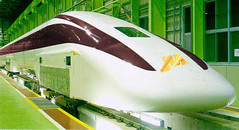
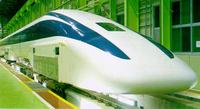
-I never grow tired of this image. It is a modified JR-Maglev trainset in Maroon & Gold paint job including emblem leading to the phrase; "Even Maglev trains love Maroon and Gold" ;-)

One of the advantages of option 1, the 150+ mph technology using gas turbines is that it can run on upgraded but existing infrastructure, allowing for an incremental approach to investment, “while the two higher speeds require new dedicated systems built from the ground up” (TEMS, 2003, p.5).” Options 1 and 2 were projected to be cost effective, returning a cost to benefit ratio of about 1.4, while the maglev option was projected to have a cost benefit ratio of .56, which is less than 1(TEMS, p. 34). The infrastructure costs of maglev are estimated to be $70 million per mile (TEMS, p. 27). This suggests that while maglev may have high ridership and revenues, they are not high enough to offset the higher costs of infrastructure and maintenance associated with maglev’s high tech guideways. Detailed figures from the report and the route alignment can be viewed in the Appendix.
The Midwest Regional Rail Initiative Study
The Midwest Regional Rail Initiative (MWRRI) is a “continuing effort to develop an improved and expanded passenger rail system in the Midwest” (TEMS, 2004, p. 4) The initiative was supported through the cooperation of the nine Midwest states and their Department of Transportation (DOT) offices along with a steering committee of key staff from each state agency and Amtrak. This report updates prior reports describing infrastructure and capital equipment costs as well as ridership and operating costs for the expansion of passenger service in the Midwest.
The MWRRI describes potential passenger rail service between a variety of cities including the Twin Cities and Chicago. In this plan, Chicago would be the hub of increased passenger rail service in the region. The plan suggests that efficiencies in the use of equipment and employees could be achieved by cooperation (between states) and that increased ridership could create opportunities for volume discounts. The potential for improved service with lower costs provides attractive alternatives to current travel options.
The elements of the MWRRS plan are to: use current rail right-of-ways to connect rural, small urban and major metropolitan areas; to introduce modern train equipment operating up to 110 mph, and improve reliability and on-time performance. The MWRRS projects that 13.6 million passengers per year would use this system, which is four times higher than the current level of service delivers (TEMS, 2004, p. 9). A fully implemented system would provide 6 trips per day between the Twin Cities and Chicago. The travel time would be 5 hours and 31 minutes. The route is projected to deliver a positive cost benefit ration of about 1.4. The report assumes that the service would make use of gas turbine technology, which could be replaced by electrification at a later date if ridership is high enough to justify the higher costs. The Federal Railroad Administration estimated in 1997 that a Midwest rail passenger system would provide the highest level of economic benefit associated with rail investment, second only to the Northeast corridor.

Rails Contribution to a Sustainable Future

Sustainability “refers to economic development that meets the needs of the present without compromising the ability of future generations to meet their own needs” (Encyclopedia Britannica, 2007). Tied into this is Sustainable Development- that follows the same principle but emphasizes “using renewable natural resources in a manner that does not eliminate or degrade them- by making greater use, for example, of solar and geothermal energy and recycled materials” (Knox & Marston 2004, p. 258).
Currently in cities around the world, the focus of sustainable development is on buildings and the companies that create them. Rating systems, such as the U.S. Green Building Councils (USGBC) Leadership in Energy and Environmental Design (LEED) guidelines, are designed to “promote a whole-building approach to sustainability by recognizing performance in five key areas of human and environmental health: sustainable site development, water savings, energy efficiency, materials selection, and indoor environmental quality.” The benefits of a LEED certified building are:

• Lower operating costs and increased asset value
• Provide a healthy and comfortable environment for their occupants
• Reduce waste sent to landfills
• Conserve energy and water
• Reduce harmful greenhouse gas emissions
• Qualify for tax rebates, zoning allowances, and other incentives through municipalities
(U.S. Green Building Council, 2007)
However, transportation continues to be a major user of energy and contributor to pollution. Sustainable transportation planning contributes to sustainability by “reducing automobile dependence, increasing use of public transit, and encouraging more reliance on nonmotorized modes such as walking and biking” (Bae, 2004, p. 363). In 1991, Congress passed the Intermodal Surface Transportation Efficiency Act (ISTEA). This Act introduced the sustainability paradigm into transportation planning. ISTEA broadened transportation policy from increasing mobility to addressing the issues of energy consumption, air pollution and economic competitiveness. Next, in 1998, Congress passed the Transportation Equity Act for the 21st Century (TEA-21). ISTEA and TEA-21 allowed funds that previously would have been allocated to highway construction to be used to develop walkways, bikeways, and public transit. Regional transportation planning agencies gained influence, and public participation was integrated into the transportation planning process of metropolitan planning organizations such as Minnesota’s Metropolitan Council (Hanson, 2004).
Smith (2003) states that a significant environmental advantage of railroads is their ability to run on clean forms of electricity, thus reducing emissions and conserving hydrocarbon fuels. He uses Switzerland as an example where all trains are electric, and 97% of their power comes from renewable hydropower. However, Electrified high-speed rail systems such as the TGV, ICE, and Shinkensen provide incentives for continued investment and development of better renewable energy sources and further reduction of the United States dependence on fossil fuels. Alstom Systems, a major transportation manufacturer and service provider, is joining the green bandwagon as well. One of their latest rolling stock brands, the Coradia Lirex: X-60 commuter train, was manufactured to reduce environmental impacts by being composed of lightweight materials thus reducing energy for movement. In addition, 95% of the material used to manufacture the train cars is recyclable (Alstom, 2004). Since 2005, Sweden’s Transport Company SL has begun to implement the X-60 and steadily replace its current fleet of commuter trains.
Investment in transportation infrastructure presents an opportunity to influence land use patterns in cities and metropolitan areas. In recent years, urban planners and policymakers have looked at rail transportation to achieve “smart growth” or transit-oriented development guidelines that provide higher densities, mixed-use developments, and increased transportation accessibility. Linked to these investments is the promise of economic revitalization for central cities and limiting the effects of “urban sprawl” often characterized by low-density and dispersed land use patterns and associated with the construction of express highways in metropolitan areas (Giuliano, 2004). By locating stops in existing urban areas, high-speed rail provides an opportunity to reconfigure land use patterns surrounding central stations and specific suburban growth areas. High-speed rail can also connect to local transportation systems such as light rail, commuter rail, and bus services creating regional multimodal transportation hubs that ease passenger transfers from regional to local and from one mode to another.
The Sierra Club includes these benefits in its reasons for supporting high-speed rail:
• HSR terminates at convenient downtown stations and also serves carefully selected suburban train stations
• HSR stations strongly encourage the redevelopment of pedestrian & transit-friendly office districts
• HSR stations are often shared with earth-friendly commuter rail trains that serve numerous far-flung suburban points
• HSR stations often feature direct connections with equally earth-friendly urban transit systems
(Karol, 2003)
With successful rail renewal in other industrialized nations of the world, passenger train stations are no longer just places to pass through to reach a destination. Rather, stations have become the center of activity for communities; with grand common areas for travelers, opportunities for vendors to set up small shops, and connections to other modes of mass transit in the community (Thorne, 2001). A project that ties into California’s high-speed rail plan is the redevelopment of the San Francisco Transbay Terminal into an intermodal hub for bus and rail systems including the high-speed plan, and a new neighborhood featuring San Francisco’s next super tall skyscraper. Advocates claim that the project has the potential to become the “Grand Central Terminal of the West”. The Transbay Joint Powers Authority (TJPA) hopes to begin construction of phase 1, the transit center, in 2008 and have the entire project complete by 2019 (TJPA, 2007). Plans for Minnesota include an intermodal station for Minneapolis next to the planned Twins Stadium that provides a connection between the Hiawatha line and the Northstar Commuter rail line (Meyer Mohaddes Associates, Inc, 2002) and redevelopment of St. Paul’s Union Depot that was mentioned earlier in the paper.

Conclusions and Recommendations

Based upon these findings, high-speed rail is needed in the Upper Midwest to add redundancy to the national transportation system, reduce congestion on our over burdened airports and expressways, limit transportation’s impacts on emissions, and continue to encourage sustainable development in our region’s major Metropolitan Areas.
However, Minnesota should be cautious in its pursuit and implementation of high-speed rail with both the Rochester Rail link (RRL) and the Midwest Regional Rail Initiative (MWRRI). A rail connection should still be considered between Minneapolis International Airport and Rochester. Rochester is the third largest city in Minnesota and home to the Mayo clinic, a major international destination. With high costs and limited land associated with expansion of Minneapolis International Airport, a rail line to Rochester would allow for Rochester to expand its airport facilities while reducing the number of cars on highway 52.
However, rail advocates that hope for Maglev trainsets zooming across Southeastern Minnesota at high speeds (including myself) should not hold their breath. Based upon the cost to benefit ratios for the Rochester Rail Link feasibility study by TEMS in which Maglev was below 1 at .56 (did not break even), Maglev remains an alluring but expensive mode choice with the majority of the cost in the construction of the guideway. However, in a few years if a new study results in a more positive ratio due to lower implementation costs as the technology becomes more readily available then the mode could be considered. However, until such time Maglev and Minnesota does not make financial sense.
For the Midwest Regional Rail Initiative, there are several changes that should be implemented. These include the creation of a high-speed rail authority for the region, the establishment of dedicated passenger rail right-of-way alongside existing transportation corridors, and eventual electrification of the entire network.
Due to the uncertain future of Amtrak despite continued federal subsidies and increasing ridership on specific routes, high-speed rail in the region could potentially be better served by a unified high-speed rail authority with the ability to contract out services such as operations and maintenance but with oversight by the involved states. This would allow the passenger service to be more entrepreneurially focused and limit the amount of annual subsidy.
Currently, Amtrak’s passenger trains share railroad rights-of ways with freight trains. Due to this, passenger trains must yield to passing freight trains that often results in significant delays or worst-case fatal collisions. Due to this interaction, the Federal Rail Administration requires strict weight regulations for crash safety standards. If the Midwest Regional Rail Initiative were to acquire dedicated passenger rail rights-of-way, passenger and freight rail interactions would be reduced if not eliminated completely. This would allow for faster travel times between stations as well as offer a wide variety of lightweight, fast, and energy efficient trainsets. Grade separation from roads could also be tied into dedicated passenger right of ways.
Lastly, railroad rights-of-way should be electrified through renewable energy sources allowing for rolling stock that draws power directly through overhead caternary systems rather than use gas-turbine trainsets that can only reach speeds up to 150 mph. Electrified trainsets possess the power to sustain high speeds of up to 350 mph, a speed that a few years ago could only be reached with maglev systems.
Almost all of these recommendations result in higher capital and maintenance costs, however, some of these changes would allow for true passenger rail renewal and allow the United States and Upper Midwest to catch up to what the rest of the industrialized world has enjoyed for 40 years. Come the revolution, let us bring high-speed rail to the Midwest.


And so there you have it, I thought about adding in Modifiable links to make it shorter, or to have people jump to or through different sections, but I am afraid I don't have the HTML know how to do it.
Man, 3 AM, time to get to bed.
Nighters Blogoshpere and hopefully these trains will be rolling soon.

Monday, May 07, 2007

A Response, A Response!!!

From a previous letter/post.
From the Office of Governor Schwarzenegger:
Monday May 7th, 2007.

Thank you for writing to Governor Schwarzenegger to share your thoughts and concerns about highspeed rail. The Governor appreciates hearing from people who care about the important issues facing our great state.

In November 2006, California voters approved one of the largest bond packages in the state's history. This money represents a considerable down payment on repairing and building our infrastructure and boosting the public services necessary to preserve our quality of life. And, with the tremendous population growth expected for California over the next two decades, the Governor has put forward an even broader proposal that will include funding for flood control, schools, courts and the correctional system.

Because of the critical need for funding these other forms of vital infrastructure, California has a limited ability to borrow money for a full high-speed rail bond measure right now. Governor Schwarzenegger's comprehensive Strategic Growth Plan, and its varying bond components, cannot happen simultaneously with the high-speed rail bond without putting the state into a position of spending General Fund dollars at too-high levels. This approach instead protects California's credit rating and support for other important state programs.

But the Governor's proposed budget does recognize that high-speed rail is a viable transit option worth exploring for the future, and so it includes $1.2 million for staff support of the High-Speed Rail Authority. He is also willing to consider other potential payment options for such a rail system, including private financing.

Again, thank you for taking the time to write and share your thoughts with Governor Schwarzenegger. He welcomes any comments that can help improve the future of California.

Sincerely,


Office of Constituent Affairs


-I am very impressed that I actually got a response, and related directly to the topic that I inquired about. While I am a little disappointed that the Governor can not fully fund the measure, I am pleased that he is including funding for the High Speed Rail Authority. Now it will be up to Rail supporters to vote on funding the plan a priority along with the measures in the Governor's strategic plan.

Wednesday, April 25, 2007

A letter to the Terminator of California...I mean Governor

Having recently read that Governor Schwarzeneggar plans to cut funding for the California High Speed Rail plan, I wrote him a letter asking him to reconsider:

Dear Governor Schwarzenegger,
My name is Andrew Wambach, I am a senior Urban Studies undergraduate at the University of Minnesota. This semester I am writing on the topic of High Speed Rail for the United States, specifically the Midwest. During my research, I stumbled upon the California High Speed Rail Authority's presentation on developing High Speed Rail to link California's major city centers by 2030. It is my hope that you will support this plan and be the true moderate Republican you have become.
I have to admit, I was skeptical when you took office. Not being a resident of California it was easy for me to tease and mock along with other Democrats "oh watch out for the Governator", then again our state did have Jessie "the Mind" Ventura, and he helped build our first and so far only Light Rail line.
It was when you began to distance yourself from President Bush and to address the issues of global warming and how California can innovate and prosper by creating new High Tech jobs and leading the way for the rest of the country in solving these problems that you should hope to be a good politician.
In a similar way, High Speed Rail accomplishes this and fits into your plan of renewable energy and sustainable development for California and the next 20-30 years.
While High Speed Rail exists in the Northeast Corridor between New York and Boston, California's plan could have rammifications for the West and Midwest and truly lead to passenger rail rebirth, not under Amtrak, but under the for-profit State High Speed Authoritys.
We need the first one that connects the lartgest state of the Union Governor Schwarzeneggar; California's is the best in regards to ridership, benefits to buisness and redevelopment, and protecting California's environment. Think of the boon to tourism as well.
California is the 5th largest economy in the world, don't be Jeb Bush and slowly kill a project by reducing funding or repealing amendments.
I hope California continues to prosper under your leadership and that the goodwill you have shown to the green revolution was legitimate.
Thank you,
P.S. Have always been a fan of your films, Commando is an all time classic as well as your signature role: The Terminator.

Regards from Minnesota,

Andrew Wambach
University of Minnesota

-We'll see if I get a response. Coming down the the wire in regards to the thesis, seems to be all I can talk about lately. Had a job interview for the summer with the city of Fridley in their Code Enforcement Department as an intern. I should hear back from them tomorrow whether I have received the position or not.

Hoping to have some employment after graduation, so that I can buy a new camera and take some more pictures with the Kristen and myself.

Saturday, April 21, 2007

Something that has been occupying a lot of my time

And Finally it is to a point where I can stop. For the past couple of weeks I have been working on a presentation to go along with my Senior Thesis: The Need for High Speed Rail in the Midwest. What began as a few bits and pieces from other movies acquired online at a length of roughly 4-5 minutes, has now evolved into a close to 9 minute project. Last week at our class meeting, I asked my professor if I could use it for the presentation to which she said no :-(.
However, I showed her the clip I was most proud of (Part 3 of the video which I will embed from YouTube) an she said that it looked like I had put a lot of work into it, and that I should be putting this much work into my paper instead.

Here is the finished product:


I am thinking about shortening it and submitting it to the sustainability film contest, submissions are due next week. However, I have a lot to do still with my paper and with only a few weeks left of the semester, there is not a lot of time to waste time...

As for news, Friday morning (April 20th, 2007) I had a job interview with the Minneapolis Housing Inspection services division through the office of Public Safety in Downtown Minneapolis. I feel pretty confident about the interview and should hear back from them soon. I also have applications circulating some of the Community Development positions of cities around the Twin Cities, yet, so far I have only heard that my applications were received but not if I am to have a chance for an interview.
Hopefully I can have some form of employment after graduation (May 11th) and try to figure out where I should concentrate my skills acquired through the Urban Studies Program.

Enjoy the film

Tuesday, January 23, 2007

All right Senior Thesis: Game On

I touched on this topic at the beginning of the New Year, but here are some thoughts that have materialized in the past few days with my Senior Thesis Writing Seminar:

Possible Topics:
From Blog Photos

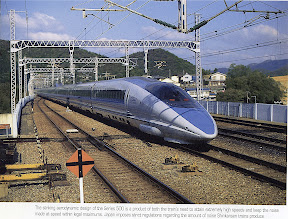
Too often I have used European examples of High Speed Rail; Not this time, the above image is of the Nozomi Series 500 Shinkansen in Japan from Bullet Trains. According to sources on Wikipedia, The Nozomi can reach speeds of 320km or 200 MPH, but is currently only operating at a maximum of 300 km or 186 MPH.

1) The Need for High Speed Rail (HSR) in the Midwest.
The idea came to me while I was on Study Abroad participating in the Scandinavia Urban Studies Term (SUST) through HECUA last semester. It was very easy and reasonably priced to get on a long-haul train and go from Oslo-to-Bergen in roughly 6 hours. At the end of my term, I attended a conference on the development of High Speed Rail (HSR) corridors in Norway that included High Speed proposals with service from Oslo-to-Trondheim and Oslo-to-Bergen.
This got me curious as to why the United States did not have a High Speed Rail network and what was being done in the field. Over break I began reading a few sources, particularly High Speed Rail Policy for the 21st Century by Anthony Pearl and read over the 2004 Executive Report of the Midwest Regional Rail System
My paper would be similar to these sources of looking at European HSR applications and then determining policy solutions, amounts of financing and sources of financing, as well as feasibility for applications in the Midwest to connect to HSR networks pre-existing predominantly in the Northeast corridors (Acela, formerly the Metroliner).
From Blog Photos
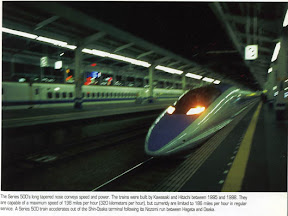
Another picture of the Nozomi 500 Series Shinkensen

2) I-494 Transitway Study
This topic would directly relate to my internship at the State Capitol with Rep. Ann Lenczewski and is a topic that is directly related to the Twin Cities MSA and the South Metro. This would be a preliminary model study of transit options for the I-494 Corridor including: BRT, LRT, and possibly PRT. This study would then be used to inform Rep. Ann Lenczewski to propose legislation for funding of a true study conducted by the Metropolitan Council.
Through my internship I will have contact with major stakeholders involved in the study. However, since there has been no formal study of transit along I-494, it may be difficult to find sources directly related to this topic.

And yet another question, which of these topics would you choose, and which one in your opinion would help Minnesota and the Midwest the most?
Whichever way it goes it should be a fun semester and a interesting senior thesis. Wish me luck.

Sunday, January 15, 2006

The Drive Home…Franky J Style and Geek Out

Last night was rough. As I stated in an earlier post, I think I had way too much beer and wine to drink last night so that made it difficult to fall asleep right away. Not being able to fall asleep I turned on Star Wars Episode III: Revenge of the Sith and watched for about an hour before calling it a night. About 20 minutes into the movie, Kristen came down from the Loft and joined me on the Futon and watched some of the movie with me and in the process fell instantly asleep. Hopefully the two of us will get a chance to watch the entire movie all the way through some time.

This morning all of us woke up around 11:00 AM and enjoyed some coffee and tasty breakfast assembled by Kevin’s parents Tom and Shelly. Breakfast consisted of fluffy waffles, scrambled eggs, and sausage links that just as yesterday all quickly disappeared. With breakfast consumed, we all began cleaning up and packing in preparation for the great departure back to the Twin Cities. Frank was able to convince all of us into some great group photos that I hope turned out well. I will have to link them as soon as Frank posts them on his Flickr page.

After signing guest books and saying our goodbyes, we hit the road. In fact, we are on the road right now and just stopped for some gas, refreshments, and correct directions after not taking 33 South off of 53 South. Hopefully the road we are on now will get us hooked up again with 35 South bound and onto home.

I always find it interesting the daydreaming that can occur as a passenger on long road trips. Sometimes when I see large open vistas along the road, I imagine them being the site of large battles between Human Soldiers and the Machines like in the Terminator films, or large walking tripods from alien invaders patrolling the landscapes for human survivors like in War of the Worlds and many other science fiction stories. In drives to our lake cabin on Tuluby, I would often imagine Dinosaurs from Jurassic Park living in the woods along highway 113. The T-Rex would jump out into the middle of the road and snatch up an unsuspecting deer before it collided into our car and that the only animal we had to stop for was the heard of Brachiosaurs going to Bad Medicine Lake for a drink.


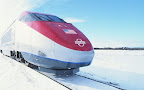
Lately I imagine myself in a high-speed bullet train (like the one pictured above) enjoying a flick, checking my email, or getting a drink from the dining car. I look out the window and watch the terrain and scenery change as we travel from the dense urban centers of Minneapolis and St. Paul to the small towns we pass through on our journey to wherever adventure calls our names. The other fantasy of mine, is being in the cockpit of an advanced atmospheric/interstellar fighter or interceptor that is flying over an abandoned Earth, devoid of human life. All that remains is the built infrastructure of radial railways, highways, and surviving structures a thousand years after a great war. I am a pilot from a great vessel known as the Battlestar Galactica or the Pride of Hiigara from the game Homeworld 2 who has only heard of Earth as the legend of the “13th tribe” of humans that left our home system thousands of years ago.

Sorry for the “geek out”. Battlestar Galactica on the Sci-Fi channel is one of my favorite shows on right now. I like the ideology that the show follows of “life here, began out there”-to quote the original series from the 1970’s and that somewhere in the depths of space there is another race of humans or "brothers of man". I think that’s why I like Science Fiction that involves entities such as “The First Ones” from Babylon Five, “The Ancients” or “Gate Builders” from Stargate SG-1 and Stargate Atlantis, or terms such as “The Forerunners” or “Progenitors” that are used in many Science Fiction books. These entities are often referred to as the Universe’s first beings and the oldest, wisest, and most powerful races ever created that have been there since the beginning, but have evolved beyond our universe and await us to join them “Beyond the Rim” to quote Babylon 5. I like these explanations of the Creator and the Universe and our eventual role that we as the human race may someday play. The Universe is far too large for Earth to be the only planet with "intelligent life", and if it is only us it sure would be a waste of an awful lot of space.

I know I kind of went off topic for a while, but this was fun to write about and plus I am in a car and can’t go anywhere or even nap. Plus, since WI-FI isn’t available on all of major US Highways yet, there is not much that I can do with the lappy, so I shall sign off and ponder about which photos I would like to add to this post before I publish it on “Aint Nothin’ But A Drew Thing”.

Until next time,

Andrew

The Battlestar Galactica BSG-75 (above) Commanded by William Adama

“SO SAY WE ALL”
Dedicated to the last remaining Battlestar…The Galactica. May we some day build a kick ass warship to be humanities last hope in the battle against evil and oppression.

Saturday, October 01, 2005

Zoom Zoom Zoom, not in a Mazda, But in a freakin’ fast train!!

All right, for all of you readers who complained about the CC post, this will be one of my last entries on Transportation Issues in the Twin Cities. On a side note, it is my Major here at the University and if you don’t like it don’t read it. It’s as simple as that.

Over the Summer, I was working at Minnetex over on the West Bank of the University of Minnesota. I would get up in the morning and ride my bike along the transitway between St. Paul campus and East Bank; then make my way to Wiley Hall. The ride was about 5 miles from the house on Lindig to the West Bank and took me about twenty-five minutes to a half hour to get to work.

As I was riding, I noticed the existing rail infrastructure that ran parallel to the transitway and into the big industrial complex near the Huron lots. I also noticed the seldom Campus Connector that would run past from time to time. It was Summer and the busses weren’t running as often as they do during the school year. The rails were often empty, except for the occasional large freight train burling down the tracks at top speed, and another morning I was up early enough to cross over the tracks and see an Amtrak passenger train making its way towards St. Paul.

One particular morning it was raining really hard, and I had slept in so I was already late for work and had missed the Campus Connector at Gortner. As I am riding I am thinking to myself, “This really sucks, why did I sleep in? I swore my alarm clock went off, and on top of that I have to ride in the rain!! I wish there was a faster way to get where I am going.” And then it came to me. One of the craziest ideas I had of the summer, building a Maglev line between the St. Paul campus and the East Bank.


Maglev Train

Maglev stands for Magnetic Levitation and is a transportation technology involving the use of magnets to propel passenger trains at higher speeds than existing rail technology. There are test guideways in Germany and in other countries and China has already developed some lines that use this technology. We discussed this technology in my Fundamentals of Transit Planning class last semester. My professor had been to the test track in Germany and had a chance to ride on it. Speeds could be reached of upwards of 256 Miles per hour, but where not tried any higher due to the length of the guideway.

There are some disadvantages associated with Maglev. The first and most important is the cost of building and maintaining the guideway that maglev runs on. Maglev runs similarly to a monorail type of track, no rails, often just concrete with lots and lots of magnets and sensors built into them. This is why the technology is not as popular as it could be. Most of the world still has a ton of regular rail infrastructure that can be upgraded for the use of High Speed passenger trains as has been done in most of Europe and Asia, but not here in the United States. The cost of building the new guideway is often what kills the enthusiasm for the project.

However, if the University of Minnesota and specifically the Center for Transportation Studies where to try and get a test track similar to the one in Germany , we may be able to get some of the cost of the guideway paid for by the Federal Government. I know a lot of students would rather see a stadium ( I want one of those too) or reduced tuition (me too as well), but imagine for a second, getting on a train at the newly completed Gophers stadium after a Gopher victory, and being “zoomed” over to the St. Paul Campus in under 7 minutes!!! Same with people who have live on St. Paul campus or near the St. Paul campus (as I do), they could get themselves to the St. Paul Student Center and then take the train to the East Bank. The system could later be extended to the West Bank, and could initially connect the State Fair grounds as well and limit the number of buses coming from the Huron lots.

I don’t know about the rest of you, but the idea of getting on a train and being able to travel from the St. Paul campus to the East Bank in under 7 minutes compared to the bus system (which is great I admit) that takes 15 minutes to a half hour, will sound awful nice come December.

In the meantime, see you on the bus!!

Andrew