Showing posts with label Minnesota. Show all posts

Wednesday, February 17, 2010

NEC 25th Birthday!!!


Posted by Picasa
Photo courtesy of the wonderful staff @ the Neighborhood Energy Connection
624 Selby Avenue • Saint Paul • MN • 55104 • Phone: 651.221.4462

The NEC invites YOU to join us in CELEBRATING 25 YEARS of conserving, cycling, recycling, building community, driving less and driving change in the world.

Party with the NEC, HOURCAR members, celebrities, friends and supporters. We will be serving Summit beer, root beer, Chipotle burritos, chips & salsa, and cake.

Come one come all for great food, games, live music and fun

Thursday, February 25
6:30 PM - 8:30 PM
SUMMIT BREWING CO. - The Ratskeller Room
910 Montreal Circle
St Paul, MN 55102
Tickets are $25 and can be purchased by calling (651) 221-4462 ext. 136. Visa/MasterCard or checks accepted.

If anyone out there still reads the outpost known as "Nothin' but a Drew Thing" you know that I usually focus on issues related to Land use and Transportation (HSR, Woot!!), descriptions and photos of major occurrences in my corner of South Minneapolis, and whatever else crosses my Radar.

But now I am taking a big leap into the world of Home Energy efficiency, Compact Fluorescent Light bulbs (CFLs), and Water Heater blankets, my specialty ;-)

In late January I started working with a great group of people over at the Neighborhood Energy Connection (NEC) as a crew member for one of their many programs: The Home Energy Squad (HES).

I have only been on the job for a few weeks and already I have been exposed to a lot of information on how simple, low cost improvements can result in significant energy use reductions and savings for home owners in the Twin Cities Metropolitan Area.

We are hoping to have a strong attendance to our 25th Anniversary party, so if you consider yourself a home energy efficiency junky, a fan of delicious CHIPOTLE burritos, live music, and a great group of like minded people we hope that you can attend.

P.S. Xcel energy has partnered with major retailers in Minnesota offering its energy customers CFL light bulbs for as little as $1.00 per bulb, this is a great opportunity for home owners to replace their most used light fixtures with CFL bulbs that come in various shapes and lumens:
From the Wikpedia:

The lumen (symbol: lm) is the SI unit of luminous flux, a measure of the power of light perceived by the human eye. Luminous flux differs from radiant flux, the measure of the total power of light emitted, in that luminous flux is adjusted to reflect the varying sensitivity of the human eye to different wavelengths of light. The lumen is defined in relation to the candela by

1 lm = 1 cd·sr

That is, a light source that uniformly radiates one candela in all directions radiates a total of 4π lumens. If the source were partially covered by an ideal absorbing hemisphere, that system would radiate half as much luminous flux—only 2π lumens. The luminous intensity would still be one candela in those directions that are not obscured.

Not sure when the program ends, hoping to get to my local Home Depot and pick up a bunch for the fixtures I use the most.

Thursday, August 23, 2007

When the professionals are kicked out of Government…

…The results can be tragic.

I have not written in a while, and I have not posted my own photographs of the site because I have not been there to document it. Personally, I didn’t feel the urge to rush down to the river crossing (at the time of the collapse I was at my cabin in Northern Minnesota with my mom and Kristen) and take photographs while first responders and survivors risked their lives to get as many people out of harms way. In fact, a part of me is ashamed of all the people who flocked to the bridges, or to buildings with the best views for glimpses of the tragedy; at the Riverfront Guthrie in DT Minneapolis, staff began asking people if they had tickets for the evening performances, it was getting that crowded in the many observation decks and viewing areas of the theater. It was as if on-lookers were trying to become the next National Geographic photographers and the assignment was to document a catastrophe in your local community. I cheered when I read that two photographers were arrested by Minneapolis police for jumping security fences. I am sure that if one were to check Flickr by searching I-35W Bridge collapse, they would find close to 1,000 pictures. /End of Rant.

I have not written for a while for a number of reasons: In my last post I had a job with the City of Minneapolis and that job has since come to a close in Late July/Early August and I have been spending the last few weeks job hunting for the fall. On July 15th, my Grandfather Wallace J. Wambach passed away unexpectedly at the age of 82 from a heart attack. My brother, has a great post about one of the many memories with “Umpa”. I have been slow in deciding what to write about for my memory of my Grandfather, recently we had been chastising each other about the condition of the Cabin’s sanitary septic system and that I should be the one to inspect it.
I have been spending as much time as I can with the KU, who at the time is also applying for jobs. So far this summer we have been rollerblading quite a bit at the Three Rivers Park Recreation area (also known as Elm Creek Park), Kristen has been brushing up on her tennis skills in an attempt to teach me, and enjoying some of the mid-summer blockbusters including Transformers (my favorite), Harry Potter: The order of the Phoenix; but more on that in another post.

Onto the topic of the post:

While the reasons behind the I-35W Bridge collapse are still to be determined by the NTSB, and perhaps will be for some time, the blame and finger pointing is in full swing. I can’t believe the sheer number of cries from Anti-Tax citizens taking shots at Light Rail and Mass Transit projects as the number one culprit in this disaster. This is particularly interesting, considering that LRT and Mass Transit often REDUCE the number of cars on the road by providing ALTERNATIVES for those to get to and from their destinations.

However, the problem that plagues American government has persisted since the Republican take-over of the early to mid 80’s; when Moderate/Conservative Republicans made alliances with powerful Anti-Tax/Anti-Government entities (namely those who would lead the Neo-Conservative Republican Hi-jacking of the party) and removed professionals from many of the large departments in State and Federal governments. These professionals were replaced with Political appointees to enforce the agenda of the sitting administrations.

Recently the Star Tribune published a great editorial describing this very problem.

Another Bridge, a different outcome
August 22nd, 2007
Braun, a professional civil engineer, headed the Minnesota Department of Transportation from 1979 to 1986, serving Republican Gov. Al Quie and DFL Gov. Rudy Perpich. In 1982, he said, he saw corroded steel plates at the Smith Av. High Bridge, and heard the same thing from inspectors he'd heard for three or four years running: "There is oxidation on the plates, but it is no worse than last year."I just decided by myself that I was going to close the bridge," he recalled. The decision came out of the blue. "At that time, we had no funds programmed for the bridge; it was not on any priority list."
Nevertheless, the decision stuck. The old bridge was closed and a new bridge was built in its place. "Do what you think is right," was how Braun remembers the response of Quie, his boss, in the face of opposition by business owners adversely affected by the closure. "Quie was an absolute straight arrow," he said.
The shutdown began on a Tuesday. "A reporter asked me how the bridge could be safe on Monday but not safe on Tuesday," Braun related. "A good question. I responded that I could not predict when the bridge could fall down. It could be this afternoon, next month, next year, five years from now or never, but I was closing it on Tuesday. ...

But Braun exemplified other desirable traits in a transportation leader. He was an engineer, able to question inspectors and analyze data as only a professional can. He was decisive, and had earned the trust of the governor who backed his decision. And he was courageous. When a lawsuit was threatened over the High Bridge closure, he said in effect, "bring it on." A judge who ordered the bridge kept open would be shouldering the responsibility he bore as commissioner, and "I could sleep a lot better at night," he said. No lawsuit ensued.
None of Braun's successors at MnDOT's helm have had civil-engineering backgrounds. (Today, none of the department's three top leaders is a civil engineer.)

Star Tribune Editorial Board
Copyright 2007 Star Tribune.


August has been a very tragic and trying Month for the officials and citizens of Minnesota: to paraphrase Don Shelby of WCCO TV; we have endured draught, a bridge collapse, and now damaging floods in the South East of the state. With luck, these tragedies will lead to a galvanizing movement to fully invest in America’s declining Infrastructure.

I should also note, that the State of Minnesota should consider itself lucky that there were only minor casualties (13 confirmed as of August 21st, 2007) though many would argue that this tragedy should have never occured in the first place. It could have been far worse, and the low number reflects the excellent first responders and citizens this state has.

I have always been, and will continue to be proud of being from Minnesota.

Wednesday, August 08, 2007

Marty Seifert’s (R-Marshall) Top 5 “other places to get money before taxes”

From Todays Minneapolis Star Tribune: Gas-tax shift poses plenty of pitfalls; Representative Marty Seifert was mentioned near the closing of the article:
House Minority Leader Marty Seifert, R-Marshall, who labored to hold his tiny caucus together against a gas- tax increase last session, maintained Tuesday that "there are other places to get money before taxes."
In response to that statement, here is our short list of alternative revenue sources; enjoy.

5. Replace the bridge bake sale

4. Republican Talent Show…oh wait nevermind

3. Tolls on ALL Minnesota Bridges…It’s a fee, in keeping with Pothole Pawlenty

2. Carol Molnau Dunk Tank at the Minnesota State Fair

…and the Number 1 “other places to get money before taxes” for Minnesota’s Transportation crisis is....

1. Naming rights for the I-35W bridge.

You can create your own list at home for alternatives sources of revenue and send them to Marty Seifert c/o fixourbridgeonthecheap.com and your state representatives.

Update: August 9th, 2007

Other great ideas that we have had submitted to us:

"Win a date with Norm Coleman!" silent auction. His wife could take the photos.

Raffle tickets to the governors fishing trip

and lastly

"Bridge Rememberance Christmas Wreath" And in an especially sentimental touch, $35 for each one

Tuesday, January 23, 2007

All right Senior Thesis: Game On

I touched on this topic at the beginning of the New Year, but here are some thoughts that have materialized in the past few days with my Senior Thesis Writing Seminar:

Possible Topics:
From Blog Photos

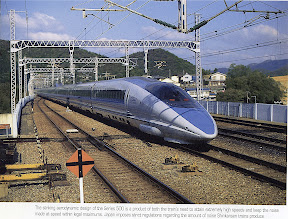
Too often I have used European examples of High Speed Rail; Not this time, the above image is of the Nozomi Series 500 Shinkansen in Japan from Bullet Trains. According to sources on Wikipedia, The Nozomi can reach speeds of 320km or 200 MPH, but is currently only operating at a maximum of 300 km or 186 MPH.

1) The Need for High Speed Rail (HSR) in the Midwest.
The idea came to me while I was on Study Abroad participating in the Scandinavia Urban Studies Term (SUST) through HECUA last semester. It was very easy and reasonably priced to get on a long-haul train and go from Oslo-to-Bergen in roughly 6 hours. At the end of my term, I attended a conference on the development of High Speed Rail (HSR) corridors in Norway that included High Speed proposals with service from Oslo-to-Trondheim and Oslo-to-Bergen.
This got me curious as to why the United States did not have a High Speed Rail network and what was being done in the field. Over break I began reading a few sources, particularly High Speed Rail Policy for the 21st Century by Anthony Pearl and read over the 2004 Executive Report of the Midwest Regional Rail System
My paper would be similar to these sources of looking at European HSR applications and then determining policy solutions, amounts of financing and sources of financing, as well as feasibility for applications in the Midwest to connect to HSR networks pre-existing predominantly in the Northeast corridors (Acela, formerly the Metroliner).
From Blog Photos
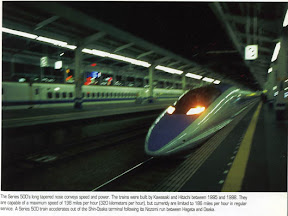
Another picture of the Nozomi 500 Series Shinkensen

2) I-494 Transitway Study
This topic would directly relate to my internship at the State Capitol with Rep. Ann Lenczewski and is a topic that is directly related to the Twin Cities MSA and the South Metro. This would be a preliminary model study of transit options for the I-494 Corridor including: BRT, LRT, and possibly PRT. This study would then be used to inform Rep. Ann Lenczewski to propose legislation for funding of a true study conducted by the Metropolitan Council.
Through my internship I will have contact with major stakeholders involved in the study. However, since there has been no formal study of transit along I-494, it may be difficult to find sources directly related to this topic.

And yet another question, which of these topics would you choose, and which one in your opinion would help Minnesota and the Midwest the most?
Whichever way it goes it should be a fun semester and a interesting senior thesis. Wish me luck.

Sunday, April 02, 2006

Whatever Happened To Planning? I’ll Tell Ya

In last Sunday’s Editorial page of the Star Tribune, there was a rather scathing article about two developments supposedly “off the grid”; the Vikings Stadium in Blaine and Target’s Expansion in Brooklyn Park. According to the article, these two projects are considered prime examples of fringe development. Fringe development is implied from the “off the grid” comment in the article.

First off, both Brooklyn Park and Blaine, although about 15-20 minutes from Minneapolis, are not outside of the 7-county Metro and are in the Metro Urban Service Area or MUSA line created by the Metropolitan Council to limit development outside of the 7-county metro. The author suggests that the council should be monitoring projects like these more closely and provide special treatment or incentive for projects locating along transit lines both existing and proposed.

While I like the Tribune’s opinion on the need of investment in public transit, I think the choice of projects is a little unjustified. Target Corporation has been in Brooklyn Park for a long time. The BP is my hometown, and there has been a lot of excitement generated around Target’s expansion of their corporate campus and the development that it will bring to Brooklyn Park.

I take offense to the notion that this project will generate sprawl. Cities that should be criticized for inducing sprawl should be Champlin Park, which has done a terrible job of curbing their rate of expansion. Meanwhile, Brooklyn Park has experienced growth over the past 30 years gradually by opening up parcels of land for developers every 10 years. This has allowed for a diverse housing stock and the potential for investment in new housing. With Target Expanding, the value of housing here will increase, great for current home owners, and it will put pressure to finish crucial transportation infrastructure such as highway 610, and redevelop areas of Brooklyn Park such as the apartments at Zane and continue the Village North redevelopment site.

Plus, the Target Expansion in Brooklyn Park is right next door to Coon Rapids; a stop along the Northstar Commuter Rail line. Perhaps, Metro Transit or Target could run a shuttle from the station to the campus?

As for development that should be criticized, how about the rapid growth that is happening beyond the MUSA line, and out further beyond the jurisdiction of the Metropolitan Council? The council dictates development inside the 7-county metro or what is known as the existing Twin Cities MSA but anything outside of it, is up to the people working in Greater Minnesota.

As for the Viking Stadium, I sort of agree. However, the stadium could do well if done right. Personally I would rather see the Vikings remain in downtown Minneapolis and the Metrodome site be redeveloped, however, if Blaine can benefit from the new investment brought by the stadium who are we to stop them?

As for the proposed “extra credit” for development locating near existing or proposed transitways, what would the extra credit be in the form of? Tax breaks? Not likely. Reduction of fees? Try again. I suggest the Star Tribune propose some forms of incentives and stop picking on Brooklyn Park and the Target Expansion.

Saturday, January 28, 2006

A Commuter Rail Line Named…Northstar


I’ll explain myself for the title. I was trying to copy “Streetcar named Desire”- a movie title with a form of public transportation in it and another movie that I hope to see in the near future. Thursday night I visited the open house/public hearing for the Northstar Commuter Rail Line which would be Minnesota’s first Commuter Rail project. Side note- last night I watched “A Streetcar named Desire” and that movie was weird.

I arrived at the Heywood Office Building of Metro Transit at 4:30 after taking the #19 bus from Seven Corners on the edge of Downtown Minneapolis and University of Minnesota West Bank. The open house didn’t start until 5:30, so I waited in the lobby and chatted with the ladies that were setting up and greeting guests as they arrived for the open house/public hearing. Through my conversations with these ladies, I found out my official title in the world of Transportation advocacy. I am now an official Rail Transit “groupie”. The ladies in the front compared me to a young man who like me was from the University of Minnesota and was a “die hard” for the Hiawatha Line and attended almost all of the public meetings. I am glad that I now possess another title in addition to my self made title of die-hard or true believer.

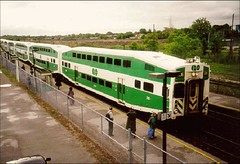
Once people began to arrive for the open house/public meeting, I began to work the floor and look at the information they had posted on numerous slides in the conference room and talk with the people in the yellow shirts that were helping answering questions and presenting figures. The NCDA or the Northstar Corridor Development Authority did a great job of presenting facts and figures, and even had a rendered animatic of the Northstar Commuter train as it would appear in operation and how the stations would look, similar to the rendering that was done for the Central Corridor a few months ago created by the Central Corridor Partnership. In some of the slides, there were renderings of the bi-level coaches that Northstar will use. I asked one of the guys in yellow, whether he knew that Northstar would buy their locomotives and coaches from Bombardier or from another company and asked him how they would do it. The man explained to me that the process is a lot more complex than just placing an order with a supplier like Bombardier. There is an entire process dedicated to acquiring vehicles that needs to go through the FTA as well and takes up the majority of resources. I assume the Met Council will choose Bombardier because we have already worked with them for the LRVs used on the Hiawatha line and will be used on the Central Corridor as well.

At the open house I ran into some familiar important figures. The first was Mark Fuhrman, the project leader of Northstar. I had met Mark during one of Frank Loetterle’s Fundamentals of Transit Planning a year ago and so we chatted for a few minutes. I told Mark that my studies in Urban and Regional Planning had continued to progress and that this semester I was taking two graduate level classes that related to transportation planning. I also told him about my small internship with Transit for Livable Communities (TLC) the previous semester and the work we did researching for the Central Corridor and how I worked with the Midtown Greenway Coalition and had attended a number of their public meetings and workshops as well. Mark seemed impressed with my activities since the last time we had talked, and I informed him that if he had any work available or possibilities for internships over the summer that he should feel free to contact me. I left my information with his staff, and I hope that is enough to at least get my foot in the door and get credit towards my Urban Studies degree. I also met with Brian Lamb, the general manager for Metro Transit who recognized me as I returned to my chair. I chatted a while with him about my recent activities and expressed my hopes for Northstar in that it puts pressure on other transit projects such as Red Rock and Central Corridor.

Also at the meeting, I met a man from my home town of Brooklyn Park. He asked me if I knew anything about the Northwest BRT line which would run along 81 up into the Northwestern Suburbs. It turns out that he lives near the Crystal Airport and has taken an interest in all of the recent articles about the Crystal Airport in the Brooklyn Park SunPost. Having not been at home, I hadn’t really had the chance to read up on the current development plans, however, my dad sent me the articles and I have since been brought up to date.

The meeting was long but very interesting to attend and see what was going on in the world of Northstar development. Also included in the plans for Northstar, was the mentioning of the potential of the Twins Open Air Stadium located next to the Minneapolis Multimodal station for Northstar and Hiawatha. When Kristen and I took the express bus 766 out to Brooklyn Park we drove past the sight, and it was interesting to observe already the condo/loft conversions underway in those areas. It will be interesting to see what further ramifications investment in transportation infrastructure will have on our Twin Cities. In Friday’s Star Tribune there was an article about an upcoming exhibit on cities and art specifically about the Twin Cities and Minneapolis and the demise of the Milling Industry on the Riverfront being shown sometime in February. I hope to make my next post about predictions on development and what the future may look like for the Twin Cities. However, to predict the future one must understand the past. With that in mind, I picked up two books both by Larry Millet titled Lost Twin Cities & Twin Cities: Then and Now both books that cover in great detail the changes that the cities of Minneapolis and St. Paul have gone through over the past decades.

To learn more about Northstar click here. Also be sure to check out my previous post on the Central Corridor if you haven’t already, at the end there are links to many Transportation related sights for the Twin Cities

Until next time, see you all on the train as the smoke rises from the engines!!! WOOT-WOOT!!!!

Andrew “the transit groupie” Wambach

Saturday, September 24, 2005

Central Corridor


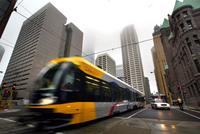
(Note) Picture on left origionally posted in the Minneapolis Star Tribune and obtained from the Metropolitan Council Website, and is of the Hiawatha LRT Line. Thought it would add to the post!!.

As I was heading over the Washington Avenue Bridge today, I had a realization: There are way too many busses on Campus. Especially on Washington Avenue, which besides University Avenue/4th St. is the main thorough fair in and out of Campus. Washington connects the two main banks of the U of M campus (East and West) and is therefore pretty busy in the morning, lunch period, and evening rush hours. This can be seen by the amount of pedestrian and bus traffic in and around stadium village during the lunch period, and the sheer amount of congestion this area experiences during the three time periods listed above.

In Geography 3371: Cities Citizens, and Communities, I have been given the opportunity through CSL (Career Student Learning) to intern with Transit for Livable Communities (TLC). TLC is a major advocacy group for the development of Transitways, bike and pedestrian friendly paths, and Transit Oriented Development in the Twin Cities metro area and region. The major focus of our group’s internship is the Central Corridor Light Rail project. The Central Corridor is an 11-mile corridor consisting of Washington Avenue and University Avenue between the downtowns of Minneapolis and St. Paul Minnesota also known as the Midway District. Historically, the Midway district was serviced by the streetcars and was a location of heavy shipping, industry, commercial, and residential development. In the 1950’s the streetcars were ripped out and replaced by the bus system, it was a very complicated issue and a number of people went to jail. Ultimately the Twin Cities lost one of the best streetcar networks in the country, and we have been struggling to get back to that glory ever since.

Currently the area is serviced by the Route #16, #50 and #50S bus lines operated and owned by Metro Transit. The Express bus 94B, C, and D operate on Highway 94 and offer express service between the two downtowns with higher speeds than the routes #16 and #50.

Our main task with Central Corridor is to help determine the actual path of the LRT and ease the process of implementation. Also, we have to consider how to keep the current residents from being displaced from new development and the higher densities that are expected (hoped for) with the running of LRT between Minneapolis and St. Paul. Which brings me to my opening paragraph. The planners want the LRT to run on the surface until Washington Avenue and then tunnel under the East Bank of Campus and then re-surface on University Avenue all the way to Downtown St. Paul. Sounds pretty cool huh?

Howver, there are some problems with this plan. If the city planner wants to tunnel, then he should tunnel starting on Washington Avenue, underneath Cedar Avenue right before the West Bank Skyway/Blegan and Whiley Hall complex. By placing the tunnel further back, we can dig below existing utility lines and have underground stations on both the West and the East bank sides of campus, with either express elevators going to the street level for campus connectors, and plaza level for students/guests etc. similar to what was done at the Lindberg Terminal. The University would be asked to contribute in a number of ways. Have architectural students create plans for University Subway Stations both at East and West Banks and any of the other stations that students interested in the project would like. At the same time, the University could buy advertising space on a couple of the trains and have them painted in Maroon and Gold motifs with Goldy the Gopher on one of the trians. At the same time, professional architects and designers will plan out station designs as well. University United should be contacted and asked to voice their opinions as well. I have contacted and worked with this group before and they are very determined to make University Avenue more like the grand Baroque Avenues and Boulevards with intense commercial, but predominantly residential development.

However, creating stations on both sides of the river could cause problems with headways and running times. There are already two-three stations relatively close to the University of Minnesota West bank. These are the Cedar Riverside Station, the Metrodome Station, and to the extreme the Franklin Station. However, adding another station beneath the west bank, could potentially decrease the amount of bus activity above ground and provide new tunnels for the Gopher way, and a true connection from both sides of the West Bank underground than across the West bank skyway.

Platforms underground would be reached by elevators or escalators (depending how far down we dig) and once on the platform the other side could be reached by pedestrian bridges that cross over to the other side, or tunnels that go under the tracks/trains and come up on the other side.

Another problem concerning the underground stations is passenger security. Underground stations would have to be well lit and potentially have barriers to entry similar to New York subway stations. Otherwise, campus security could monitor these facilities as well as officers of the Transportation Police Department. By creating barriers to entry, Minneapolis and the State of Minnesota could begin using a system like the Metro Pass; many people already buy discounted transit passes including many students who use the UPass program.
The decision to go underground was made after seeing the incredible amount of bus traffic already on Washington Avenue on campus including Campus Connectors and Shuttles, Metro Transit, Southwest Transit, and Metro Valley Transit Authority (MVTA) all operating in this space and having to contend with heavier traffic.

Now that I have covered some of the issues with the tunnels proposed by the Central Corridor, it is time we addressed some of the surface effects. I know some of you are asking me, “you started this argument with buses, get to the buses already.” I am about to do just that. By implementing the CC LRT plan; the train would replace the limited service provided by the route #50 and #50S. The route #16 would still provide service to all other stops. Most likely, the 94B would still run on Highway 94 depending upon the success of LRT.
Some classmates of mine have argued that the LRT will only make things worse along University Avenue. University Avenue is one of the busiest Truck corridors in addition to regular traffic. By running LRT down the middle, it may be difficult to maintain University Avenues uses as a truck route. In addition, two lanes of traffic may be eliminated in both directions to make room for trains and stations. To eliminate this problem, the LRT may have to be elevated similar to Chicago’s L line. Although this would increase the costs and diminish the appeal, it would allow for stations to be placed in the locations picked out and not interfere with traffic, until entering downtown St. Paul and the Union Depot which has plans to be turned into a multi-mode station for both the CC LRT and the Red Rock Commuter Rail Line running from St. Paul to Rochester.

My classmates have also argued that the CC will not solve commuting problems if there are too many stations. The CC will have to be fast, and get people from Downtown Minneapolis to Downtown St. Paul in under 30 minutes (my desired figure). The #50, can get you to downtown St. Paul in about 45-50 minutes depending upon traffic, the #16 takes about an hour or more at the most, it’s worse with traffic. If the CC can provide commuter service to both downtowns, then it might be as successful if not more than Hiawatha. We will just have to wait and see what Metro Transit and the Council decide.

The Central Corridor is a very ambitious plan. Meaning that it is going to be expensive. Hiawatha, which was a longer corridor and had more stations, ended up costing about $725 Million Dollars and that was with a trimmed budget. Because of the tunneling and infrastructure costs of elevating CC, the cost of the project could potentially be in the billions. This is why, Metro Transit, and the Metropolitan Council, need to be careful and listen to the public before going and building something as extravagant as the CC LRT. I, like most people in the Urban Studies program here at the University of Minnesota, want to see this project get the green light and pass with flying colors. To do this, the citizens of Minneapolis, St. Paul, and the region need to get involved and push for a reform in the way our Transportation system is funded. A dedicated sales tax, as has been done in many other cities in the United States, could help Minnesota reach her goal of a dedicated public transportation system by 2030, and allow for new residential and commercial development in the cores of both downtown Minneapolis and St. Paul that we are already seeing in the Loft and Condo boom. Just imagine the amount of cars on the road if we don’t invest in a new system, our entire workdays will be spent on the highways. And gas prices are only going to increase, unless our nation spearheads the move toward renewable energy sources.

Time to get down from the soapbox, but to emphasize that public involvement is needed and appreciated. We as citizens, control what is implemented. Although it may not seem like that at times under the current administration, this is still a Democracy. Citizens of this State and region have a duty to plan and anticipate the future so that we can tell our leaders what we feel is best for the state of Minnesota, our role in the Midwest, the Nation, and the Global Economy.

For any questions:
Email: wamb0011@umn.edu

For news and how to get involved in other transportation projects around the region: (URLS’s)
Northstar Commuter Rail: http://www.northstartrain.org/
Central Corridor: http://www.centralcorridor.org/
Metro Transit: http://www.metrotransit.org/
Metropolitan Council: http://www.metrocouncil.org/
Transit for Livable Communities: http://www.tlcminnesota.org/


Thank you,
Andrew Wambach
University of Minnesota Twin Cities
Urban Studies