Monday, November 27, 2006

The Final Praxis...Cheers to being done academically with SUST

Since I didn't get any sleep last night...not really sure why? Figured I would post this final praxis reflection paper. Enjoy.

Summing up
A Semester in Scandinavia

When I first came to Norway, I knew very little about the country and therefore had few assumptions about what the country was like. Unlike the others in the SUST program who had family connections here, I chose to study in Norway for purely academic reasons. I wanted to have an experience that would deepen my knowledge of urban life as it is experienced in another country. The opportunity to study public transport systems of similar sized metropolitan areas to that of the Twin Cities through the ISP was a major draw.

Because I was basically uninformed about Norway, I do not think I have experienced the shock that some of the other SUST participants have experienced. I did not have a strong image of Norway as the: “Land of the Vikings”, with beautiful landscapes, strong environmentalism, tolerance of other backgrounds, openness to all, etc. So, this program has both informed me about these images and crumbled them. The course readings and our guests have revealed growing tensions of xenophobia, consequences created by a constructed national identity, discrimination based on ethnic background, and a growing divide between the wealthy and the poor even with Scandinavia’s Welfare system. I learned that these issues are sometimes considered taboo; subjects that “we don’t talk about here”. By not having a strong perception of what Norway was before coming here, I created the understanding of what Norway is as it was presented to me in the readings and in class discussions.

After reflecting on the semester in general, I realize that I have had very few problems or obstacles that I have had to overcome. In some of our travels I have been thwarted by the airlines in getting to certain destinations (Bergen-Stavanger), yet through patience and perseverance I was able to get to those places eventually and reconnect with the group. In doing research for my ISP, my lack of ability to read Norwegian was an obstacle because important documents were only published in Norwegian with short English summaries. However, I was able to overcome this by contacting and talking to important researchers through my placement at the Norwegian Conservation Society. It made me feel proud to hear positive comments from my program director about my efforts to establish contacts regardless of my lack of experience with the Norwegian language.

Overall I think adapted very well to living in Norway. This can be attributed to the many similarities between Norway and the US in regards to daily life, which I described in my praxis regarding globalization. I was able to buy food that was familiar to me and didn’t have to eat fish eyes or something of the equivalent. My living space at Sogn was similar to that of most student housing developments in the US. I was able to make new friends, something that was a challenge for me. It is easy to rely on family and old friends rather than push myself to meet new people. I hope to stay in contact with my new friends and visit them in the future.

In addition to making new friends, I was able to survive a 4-month separation from my girlfriend who awaits my return. This period provided me with insight into what couples often face in long distance relationships including feelings of jealousy and loneliness, and the arguments that can flare up from the smallest of things. Through this study abroad Kristen and I learned a lot about each other and how we interact with one another when the conversation isn’t face to face.

Finally although I have traveled quite a bit with my family, this was my first trip alone. Before I left on this trip I was worried that things would go wrong and I wouldn't know what to do. I found that even when things go wrong, I can solve the problem. I have survived a traveling here, and the huge ordeal that was, but also arranging other trips in Europe including the trip my Mother and I enjoyed in London during the semester break in October. All of the travel I have done over the past four months has increased my confidence in my ability to solve problems and reduced my fear of traveling on my own.

Through the SUST program I was exposed to a large range of issues facing contemporary Scandinavia including the importance of national identity, immigration and integration, and the future of the welfare state. What I found interesting was how all of these large topics are in themselves interconnected to each other, and how they continue to fuel the center-periphery struggle in Norway, my core issue. I have been particularly fascinated by this debate the entire semester because it relates so closely to things that Minnesota politically is facing in the wake of increased urbanization and centralizing forces. So far this topic has been covered in several sets of critical questions and at least two praxis reflection papers.

In my first praxis paper (Wambach, Praxis 1, 2006) I summarized the work of Knut Heidar (2001) on the creation of Norwegian identity. Heider describes how Norwegian identity was created by social elites who searched for a “pure Norwegian” after gaining independence from Sweden and earlier Denmark. These elites were looking for an identity that was as far from Danish influence as possible. Thus the periphery of Norway, due to the lack of communication technology at the time, along with common Scandinavian ancestry was the perfect place to find the foundation for the fledgling identity. (Wambach, Praxis 1 page 3, 2006). As Szlachetko stated, at the time Norway achieved independence, there were no large urban areas in existence. The relative lack of urbanization, tied with Norway’s geographical conditions, mandated that the regions were more important and self-sustaining out of necessity. The traits that lead to success in a challenging agrarian environment, such as persistence, physical strength, stoicism, and self-sufficiency (or what ever you have read - throw it in here) are still championed in Norway. Yet Norway has developed large urban centers where cooperation, collaboration and tolerance of diverse life styles will be needed to avoid urban problems such as congestion, pollution and disenfranchisement of segments of the population.

Recently this issue has been brought to the forefront for myself with our recent visit with Ketil Solvik-Olsen of the Progress Party of Norway. During that talk I brought up the issue of transportation planning to which he responded quickly and without further discussion that his party favors road investment over investment in critical rail infrastructure. Andrea tried to keep the conversation going by asking whether rail transport would threaten the current decentralized state of Norway, and if favoring roads was a simple form of showing opposition. Though he did not address her question, Andrea was on the right track. In any country there are likely to be forces promoting centralization and those promoting decentralization. Transportation planning is one area of decision-making where those forces become apparent. Like in the US, those in the periphery are often opposed to projects that increase centralizing forces such as investment in High Speed Rail and public transport subsidy. Parties who are in favor of public transportation spending, such as the Social Democrats and to some degree the Conservative party, support these projects due to the benefits of centralization. Hamilton (2004) described how investment in critical infrastructure is often justified because of the creation of economic growth that often occurs as a result of these projects. The economic growth is generated from reduced costs in the movement of people and goods, jobs created while the network is being built, jobs needed to maintain new rolling stock and guideways, etc. However, one could also argue that decentralization can also be encouraged at the same time with these investments because it makes it easier to travel to and from major urban centers of the decentralized state. For example, in the USA planners argue against improving highways, because adding more lanes to roads encourages development further from the urban core called "urban sprawl". Advocates for roads argue that most people prefer to live in more rural or suburban settings and roads allow us to do that, improving our quality of life.
In another praxis I described how classic Scandinavia Literature and art support this stigma against city life. For example, Knut Hamsun’s Growth of the Soil and artwork featured prominently in the National Gallery examine the problems of urban living. Szlachetko commented that the depiction of the urban areas during the early 19th century or height of the industrial revolution often depict the misery of urban life. This is also a common feature in the US art where very strong depictions of the harshness of the urban realm and the need to escape to the peripheries can be found in 19th century literature and art.

Through the process of examining these competing forces in Norwegian culture I have become more aware of how they operate in the USA. For example, our SUST group has discussed the threat to the periphery that Norway’s potential integration with the EU creates through the targeted elimination of subsidies in the fisheries and agricultural sectors (Matlary, 2004). Political parties such as the center party that was formally the agrarian party continue to lobby for these subsidies without addressing the negative effects of continuing these subsidies such as inefficiency and lack of competition. This is similar to Minnesota where lobbyists have called for an increase in the size of feedlots to support increases in livestock production for farmers without considering any of the negative side effects such as environmental degradation through “feedlot” farming practices. I have also come to see how competing forces influence my own personal choices. For example, I believe that using mass transit is better than driving for the environment, but it is sure more convenient to hop in the car. Reconciling the need for preserving the environment with my need to travel when and where I like is a challenge.

To conclude the center-periphery debate for Norway and other states is a dialectical problem. Dialectical problems require us to combine a thesis with its antithesis, or bring together two contradictory ideas, to create a synthesis. Hanging onto core values and traditions of the past while at the same time strengthening these traditions by adapting to changing circumstances is an example of synthesis. Another example is the pursuit of High-Speed Rail to enhance centralization while promoting decentralization at the same time. Seeing problems as either or – we either have or do not have centralization – limits our ability to come up with creative solutions. But dialectical thinking is hard, especially when we are highly committed to our positions. From my vantage point as an outsider, it is easier to see need for synthesis in the problems faced by Norwegians, than it is to see the potential for synthesis in problems we face in the USA, or that I face in my personal life. I hope that as I return to my usual environment, the lessons I have learned through this study abroad experience will help me recognize and think through the dialectical problems I will surely encounter in the future.

Sunday, November 26, 2006

2 days Left in Norway

The countdown has begun for the return trip home. For Kristen this countdown has been occurring since late October and will now finally come to a close in the next two days. It is currently 3:08 AM here in Oslo Norway. I am wide awake for some reason and thought I would do some free writing to possibly make myself tired.
Last night was Saturday night, my last Saturday in Oslo, and nothing exciting happened. That’s not to say the night was a total waste, but it was close. My friends all felt tired and didn’t want to go out to the city, Mark is getting set for his trip to Amsterdam and is saving money, and I think Jennifer has a cold and I hope she starts to feel better. Saturday night consisted of sitting in Mark’s room chatting, drinking a couple beers, eating some chips, and enjoying the wonders of YouTube with music video clips featuring David Bowie and Ray Parker Junior’s Ghostbusters.
The weather has been to blame in regards to people not wanting to venture out in my opinion, then again, we are very close to the end and people need to pack who are leaving in the next few days, and then the other students here at Sogn who most of us are friends with are preparing for their final papers and exams as well, making it difficult to go out and have a good time.

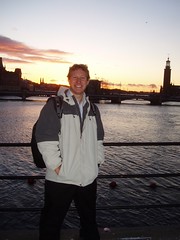
Oslo City Hall, semi rainy and cold night
Oslo City Hall - Night Shot
Just another thing I’ll have to add to the list of things I want to do when revisiting this Northern portion of Europe called Scandinavia.
I finished my Final Praxis paper earlier this evening, and yesterday I began taking down cards, photos, maps, and posters down from my walls and started to feel sad. I gave away a bunch of my kitchen stuff tonight because I wasn’t going to be cooking here again in the time between now and Wednesday morning when I plan on catching the Express bus at Ulleval Stadion to the Oslo Lufthaven (Oslo Airport). Hopefully I can have Henrike and Tobias help me load up my suitcase in their car and give me a lift down to the bus stop.
Ready to go home
The room, getting set for the departure
Tonight Alizee and Cora did some baking in the kitchen, which was nice. Alizee made a chocolate cake and offered a piece to everyone in the flat while Cora made cupcakes. I feel bad for not baking with them, I tried cooking for people a number of times and shared my meals with Marie so that she wouldn’t have to cook when she came home late a few times but it wasn’t a reoccurring thing.
Photo added 1-31-07
The last supper with the flat mates
Eating some Peppes Pizza with the Flatmates before heading back to the states, it is something that I wish I would have done more of, but upon reflection I spent a lot of time with students from other countries vs. hanging out with other Americans.
Leaving for the SUST retreat tomorrow morning at 9:30 from Ulleval Stadion, so I need to get to sleep.
Probably have one or two more posts before I leave Norway,
Cheers.

Another late edition:
Some photos from the Retreat:
Morning at Sogn
Morning at Sogn

A Cabin fit for a SUST retreat
A neat little cabin for a SUST retreat

Saturday, November 25, 2006

A Week in Review

The past week has been pretty hectic. It started Sunday night when I pulled an “all-nighter” to finish my Independent Study Project (ISP) report on Scandinavian Public Transport and the presentation that would follow later on Monday afternoon. Once I had finished the Oslo section, the most detailed, I switched gears to the systems of Copenhagen and Stockholm and was able to find some good information but not to the degree of detail that I was able to get from studying the Oslo Public Transport atmosphere through my work at the Norwegian Conservation Society and the researchers I had contacted during my time here. Suffice to say, I was able to finish the report and had a total of 17 pages single-spaced due to images and figures used in the report and created a 22-slide presentation from that report.

From Blog Photos

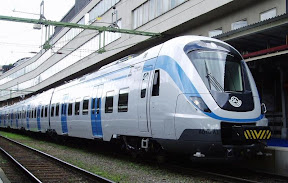
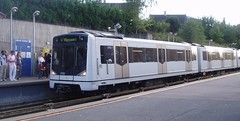
The X60 Commuter train, manufactured by Alstom
photo taken by User:Udo Schröter
date: August 2005
first upload: 16:11, Aug. 13, 2005 -­ sv:Wikipedia by the photographer
URL

The presentation went well, even though I was incredibly nervous and kind of loopy for not having sleep the night before. Tim quickly noticed that my skin color had turned to a very pale white and after our field seminar that morning suggested I go back to Sogn and get some rest. However, had I done that I wouldn’t have woken up for my presentation. So during our time between the seminar and my presentation I tweaked some things in the PowerPoint and added some extra pictures. After class, I went straight home to Sogn and crashed hard. I slept straight until about 10:30 or 11:00 PM, and then woke up for a snack. Afterwards I slept from midnight till about 10:00 Am I think, and then I had to hoof it to our seminar at the ISS classroom discussing Growth Fetishism in the world economy. Very interesting topic.
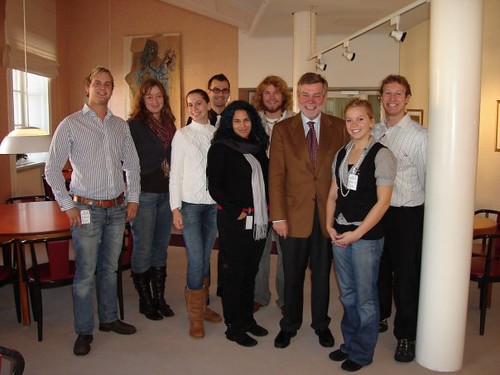
Later on Tuesday, our SUST group met with the Norwegian Progress Party at Stortinget that was very revealing. For the entire semester the Progress Party has been labeled as very Xenophobic in regards to its stand on immigration and integration issues and on the amount of foreign aid that they support. The man we spoke with, new where we were coming from politically and answered our questions very well. However, when I launched into him about High-Speed Rail and their opinions regarding Public Transport he told me straight that they supported cars over rails, however, he did not go into greater detail.
Wednesday involved the last meeting with my volunteer placement with the Norwegian Conservation Society. My advisor, Holger Schlaupitz, and I attended a High-Speed Rail conference hosted by Jernbaneverket (the Norwegian National Rail Authority) from 10:00 Am to 3:30 PM. The conference started with a presentation from a German Consortium VWI from Stuttgart, who showed the phase 1 of their analysis on the feasibility of High-Speed Rail in Norway. They concluded that the most feasible alignment for High-Speed service would be single track from Oslo to Trondheim based on market aspects. The travel time between Oslo and Trondheim would be reduced from 6 hours to 2 and half hours and serve 5,000 passengers a day. Their was a strong negative reaction from many of the attendants who were surprised that the Oslo-Bergen line was not selected, environmental effects were left out, etc. Personally I was surprised that a single track system was proposed when double track can allow for faster speeds and reduced dwell times for passenger trains at stations. Followed by the presentation from the Germans were two presentations by Norwegian proposals, the first being Den Sørnorske Høyhastighetsringen which basically means High Speed Ring route, a very ambitious project, however, is supported by the Conservative Party I think; and the second presentation was from a company called Norsk Bane AS whose website I have linked in a previous post.
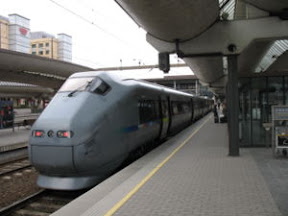
The Oslo-Gardermoen Flytoget Express Train
From Blog Photos

Origionally uploaded by Mr. Kjetil Ree, on wikipedia, origional image can be found here. Currently this is the closest thing to High-Speed Rail in Norway.

Thursday involved our final field seminar as our SUST group, when we all visited the Henie Onstad Art Center, where Maria has been working this semester and will continue to work for after the program is done. Thursday also consisted of the level 2 Norwegian students Mark, Jennifer, and Heather taking their Oral exams and then having their final Norwegian exam on Friday.
For me, Friday I spent the whole day walking around Oslo and taking care of some holiday shopping. In the evening I hung out with Tobias, Henrike, Marc, and Friederike. Marc and Friederike had visited the Freia chocolate factory earlier in the day, and told us all about it.
Now it is Saturday, and the weather sure hasn’t been cooperating this week at all. It has been raining for almost this entire week; I personally wish it had snowed but oh well. Have one more academic thing to do and that is the Final Praxis that is due on Monday before we leave for our SUST retreat where we will be staying in a hytte until Tuesday and coming back to Oslo.
Not sure what will happen this evening, but as the last partying night in Oslo, it should be a blast.

Be back in the Twin Cities soon.

Friday, November 17, 2006

Latest Addiction

This is a collection of photos and clips that I plan on using in my presentation on Scandinavian Public Transport coming up next week Monday. Enjoy, and let me know if you think it would be appropriate to include in a power point presentation.

Sunday, November 12, 2006

Stockholm Sweden

Our SUST group’s last class trip involved a 5-day visit to Stockholm. The trip began very early Wednesday morning, 5 AM for most of us including myself, and involved a scary descent from the hills of Sogn. Tuesday night, the region experienced a massive blizzard (see previous post) that had blanketed Oslo in snow, however, as the temperatures got colder the snow froze and the pavements became ice rinks. There were some parts that were so bad that you had to walk on the dirt that hadn’t froze to avoid falling to your death. Suffice to say no one wiped out that morning but there was some close calls.

While Mark and Andrea were waiting for the T-Bane, the operator overshot Ulleval Station coming into fast and skidded on the icy rails. He then had to walk all the way thru the train and back up. Mark and Andrea were kind of freaking out but managed to get to Oslo S in plenty of time. I was the first to arrive, followed shortly after by Heather, then Mark and Andrea, then Jennifer and Marea, Halvard, and then lastly Tim. He scared all of us by showing up a few minutes before we went to board our NSB train to Gothenburg that was scheduled to leave at 7 AM.

The train made it to Gothenburg in plenty of time for our connection to Stockholm, however, Swedish rail had other plans. As soon as we arrived, trains from Gothenburg to Stockholm and other locations began to be canceled left and right and one right after the other. Turns out that Sweden had been hit particularly hard by the blizzard and many of the lines that the trains used to pick up power and run had frozen in the night. Unable to take a high-speed train to Stockholm, we had to force ourselves onto a local train heading to Malmo and then transfer to another train into Central Stockholm. We made it eventually, however, by the time we had arrived we had all been traveling for over 12 hours and were very tired.

Thursday involved an entire day at the Swedish Parliament where we had the opportunity to talk with Björn von Sydow, the former speaker of the Riksdag (Swedish Parliament) and a major political figure of the Social Democratic Party. Afterwards we met with the Political advisor of the Moderate Party who recently made government as of the September 2006 elections. The advisor also gave us a tour of parliament and a description of some of the historical figures and prominent speakers.


Friday we made a trip to the US Embassy of Stockholm, where some of us were appalled by the way US citizens (such as ourselves) attempting to visit the embassy for a meeting, were treated by security personal. We met with a Political and Economic Officer who told us about the continued relationship with Sweden. It was very different than our discussion with the officer from the Oslo US Embassy, because this time we were in the actual embassy vs. the political officer coming and meeting with us on the UIO campus. That evening we had an interesting meeting with the Youth Chapter of the Swedish Red Cross and had a discussion regarding immigration, integration, and issues of asylum and tolerance of the Swedish populace. I like to think that I was potentially helpful or beneficial to our meeting with the organization. The woman that spoke with us told us about a series of stories that were written by immigrant children and specifically those who had come via asylum. The organization was hoping to publish these stories and distribute them with the ad campaign for a documentary that dealt with these issues made by another organization. I suggested that they try to negotiate a deal with the Stockholm Underground, famous for its public art, to put up some of their stories in high traffic areas up until the premiere of the documentary to increase awareness of the issue, potentially increase recruitment, etc. After our meeting, we all did our assignment of studying the Stockholm underground at two or more stations and finding the public art featured there. We later gave presentations on our finding on Tuesday of last week.
Fun with blurry images
And speaking of the Underground, here's a great vid I recently found on YouTube featuring one of the C20 Subway car, same as the one pictured above, uploaded by godisp:


Saturday we all made a trip to the Modern Museet and were given a tour by one of our classmates Marea who has worked for the Minneapolis Institute of Art (MIA) and is now working for an art museum here in Norway. From there we were given free reign to explore the city. I took the opportunity to find the Stockholm museum of public transport. After a long walk from the T-Banneren I finally found the museum with about a half hour before it closed. Thankfully I didn’t have to pay admission because I had a valid transport pass even though for students it wasn’t that steep. Overall my reaction to the Museum was about the same as my reaction to the Transport museum in Oslo: great collection of historic pieces and photographs, however, a lack of information in English and other languages for international guests. However, the last comment could be argued that there aren’t many people who visit these museums with other languages and that I am a special case. Both museums are more geared towards children, although the Stockholm museum did have some good exhibits on the future of transport in areas of Europe as well as a great exhibit on the public art of the Stockholm underground. As a souvenir, I bought a poster that I told Mark I will place in my office. His response was “Since when do you have an office and where?” my reply was “Well I’ll have an office someday” :-D.

Saturday night we attempted to hit the town hard. We ended up going to a Reggae part that was a bust and then down to the Sentrum where we couldn’t get into any of the clubs. This was much to the frustration of Andrea. There were a couple of bars we were able to get into and get some decent beer (Guinness!!) but in regards to nightclubs there were too many bleached blond Swedes and men slipping Kroner to the guards that there was no chance we could get in. A later found out from a friend of mine, that there were some good places in Sodermalm (Southern Stockholm) that were nice and much easier to get into. Oh well, chalk that up as a thing to do for the next time.

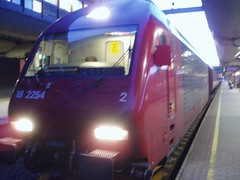
Sunday we all headed for home on a direct train from Stockholm to Oslo. After seeing some of the passenger trains around the station I knew we weren’t going to be put on a high speed line, but I could describe the train that we took as the Battletrain Galactica or at least that’s what it felt like. Unfortunately I wasn’t able to snap a picture of this battleship of a train before we left, and I shouldn’t be so harsh. The train got us home comfortably and in one piece. Monday we were all given the day off to recover from the Journey and make preparations for the week ahead. I meant to write this on that day but, things come up and priority must be given to other activities.
Thus ends the post for Stockholm, a great Scandinavian city and one that I will have to visit again.

A Glimpse into what we do pt. 2

My highest scoring Praxis reflection paper: 9/10!!!!!

Emotions Run High
Praxis 3
Weeks 9 through 11

The past three weeks have been very exciting in the SUST program. From our travels during our Semester Break, films and readings we have discussed, and organizations doing great work in many of the “hot topic” issues that Norway is experiencing.
I had recently returned from London where I got to spend a week touring with my Mom. While in London I had the opportunity to ride the underground and see many important cultural/historical landmarks and analyze their importance in contemporary European society. At the beginning of week 9, all of us back from enjoying the breaks, experienced our first hot button issue: that of the politics surrounding asylum, which we discussed heavily at NOAS Norwegian Organization for Asylum Seekers. Many of us could not fathom how someone who had been tortured almost to death would be denied asylum, while someone who was drug trafficking in the USA was able to flee and claim asylum. This will be the topic I will expand on in second part of the paper. The rest of the week consisted of the Danish film Truly Human, followed by the trip to the Modern Art Museum, and then the visit by the representatives from the University of Minnesota and our discussion with Ritika Dhall whom in my opinion, has been one of our best speakers.
The next week we discussed Immigrant literature and Ibsen’s A Doll’s House with Einar followed by a trip to the Ibsen Museum. The discussion of A Doll’s House was really helpful in understanding Ibsen’s commentary about the world and the role of women. However, during the course of the discussion it sort of felt like the mood had changed from discussing the major points of the play to how evil Men are in contemporary society and how all the advantages are still predominantly male oriented, that gender equality with all its progress still gets the response “how far have we really come?” Mark and I started to feel out numbered (4 girls, 2 guys), and then all of a sudden Mark and Andrea got into a pretty strong argument in which Mark was ripped apart without much opportunity to defend himself in my opinion. This week ended with our regional home stays in Levanger where I was able to get a glimpse of the center-periphery debate first hand. What was really surprising was the amount of negativity associated with immigration on the part of our host parents.
Week 11 has turned out very nicely with some great readings on the city of Oslo, much to the interest of this Urban Studies major. The small excursions to the suburbs were very interesting and I will have fun discussing them on Thursday in our groups.
A topic I have been interested in digging into a little further is asylum and integration. This program has opened my eyes to a topic that is filled with xenophobia, overt racism, and a topic that is often pushed under the rug as if no problem existed in this perceived utopia that is Scandinavia. In Crisp’s (2003) Politics of Migration article there was a particular section stating that because of barriers erected by nations keeping people out, more people actually needing asylum had been forced to resort to more illegal methods of getting into countries including human smugglers or trafficking. This peaked my interest due to my week in London where a major human trafficker was arrested just before I left the UK. Ekberg (2004) talks about integration of refugees in Sweden and how immigrants are distributed all over Sweden to avoid the creation of concentrations. Ritika did a great job of talking about this in Norway and the specific guidelines of the “program” for integration. What was interesting was how important the program was for integration for these new comers and if they “opted-out” they would be truly left on their own with very little success.
After our discussion at NOAS I became curious as to what the qualifications for asylum in the United States. As a student at the University Minnesotan, I have interacted with those of the Somali community and the Hmong community, both that are political refugees that fled from their countries and settled in cities in the Midwest such as Minneapolis, St. Paul, and Chicago. However, I have never taken the opportunity to look into the procedures for asylum in the USA.
Using The Wikipedia (Accessed October, 2006) I was able to find the necessary steps and this following passage:
The United States is obliged to recognize valid claims for asylum under the 1951 Convention Relating to the Status of Refugees and its 1967 Protocol. As defined by these agreements, a refugee is a person who is outside his or her country of nationality (or place of habitual residence if stateless) who, owing to a fear of persecution on account of a protected ground, is unable or unwilling to avail himself of the protection of the state. Protected grounds include race, nationality, religion, political opinion and membership of a particular social group. The signatories to these agreements are further obliged not to return or "refoul" refugees to the place where they would face persecution. (The Wikipedia, http://en.wikipedia.org/wiki/Asylum_in_the_United_States)
What is interesting is that torture is not a qualifier for asylum as was discussed at NOAS. In addition to this, there was a recent article in Aftenposten on Somalis being denied Asylum because of their dialects. Southern Somalia is where most of the fighting is occurring and people from that province can apply for asylum and often escape into another country, however, those coming to other countries leaving the Northern areas do not qualify for asylum because there is no active conflict in that region. Inspectors are questioning new refugees before admittance to determine where they are from based upon their dialects, if they match the South then they are one step closer to being allowed in, if they match the North, one step closer to deportation. (Aftenposten October 16, 2006)(http://www.aftenposten.no/english/local/article1497115.ece?service=print)
In the post 9-11 world, it is unfortunate how many people who actually need asylum are lost in the systems and red tape or sent back because of “not fitting” with procedures or programs that would mean their survival and a better life. It is also unfortunate that because of this the black market of human trafficking has become strengthened. However, there has been no punishment or real public outcry from the Western world to reform these systems, and this in my opinion is a crime.

Tuesday, October 31, 2006

My Independant Study Project - ISP


This has been the main reason behind my selection of Norway and the SUST program.


ISP- Scandinavian Public Transport

After our class visit to Copenhagen, I became interested in studying the major public transport systems of the three major Scandinavian Countries in the order our class has interacted with them: Norway, Denmark, and Sweden. The analysis will follow a compare and contrast of the systems with the following guidelines:

• Population – the size of the three capitols varies, how has this shaped their transport systems and what challenges has it provided?
• Size of Geographic area – this can be linked to population and size can be measured in hectors or square miles. This section could also feature geographical challenges for example Oslo’s Fjords and difficulties with Tunneling or because of Copenhagen with no geographic boundaries and no hills and what challenges this has presented to planners.
• The Age of the System – age is important in determining popular support and continued improvements. If the system is associated with failure, it is likely that it could fall victim to privatization. Age also has factors in condition of lines and decisions behind infrastructure improvements such as tunneling underground important sites for Metro lines.
• Sources of funding – How much of their funding comes from fair box recovery, how much is Nationally subsidized, what political institutions control them, is their a Minister of transport that oversees these operations, etc.
• Modes of transport – this would include all rolling stock of metro lines, busses, trams etc. Some of the major manufactures that have contracted with these services could be mentioned.
• The future of these systems – this would be the final chapter, expressing challenges these systems face be it in expansion, waning political support for public subsidy as is the example in Norway from the Progress Party, pressures of privatization. How will Norway’s EU membership (if it occurs) affect public transport, how are Denmark’s and Swden’s already affected.

My motivation to switching to Scandinavia and its three major capitol is to try to tie closer into the goals of the program. Tim and I have talked about how there is continuing pressures of cooperation in the Nordic countries. One of these players is the Nordic Council Ministers, whom we met with a representative of while in Denmark. It would be interesting to find out how this organization plays a role in transport. The motivation for the selection of capitol cities, is because they have the largest concentrations of people and activity requiring transport. And lastly, I would like to take back what I learn from this analysis and apply them to transport policies and infrastructure development in the Twin Cities, which was one of the main anchors in my reason for coming to Norway.

I continue to face challenges with the Norwegian Language in terms of research. Progress is being made in the volunteer placement, though I feel time is continuing to slip away. This will be the last change of the ISP. The end result will be a 15-20 page paper as stated in the syllabus in the program, and as a benefit to future SUST students a power point presentation summarizing the three major systems will also be presented.

Snow at Sogn

Snow at Sogn

Today it snowed. Pretty amazing really, even though its just snow. I think the timing is pretty interesting, considering all of us who are from Minnesota and remember the 1991 Halloween Blizzard exactly 15 years ago, that was one of the largest blizzards Minnesota ever had. For those that don't know or don't remeber follow the link. I swear, what can't the Wikipedia find?

I wasn't sure when we were going to see snow in Oslo, from a lot of people I heard we weren't going to have snow until Mid-November, but I am not suprised by this snow storm considering that Minnesota and the majority of the midwest of the USA experience their first snows in Mid-to-Late October early November. Plus it made for a great picture.

Leaving for Stockholm tomorrow morning really early, so I will need to do some packing tonight. I might have one more post later on today, depending upon how I feel. Hopefully this isn't the last time it snows during our stay, I'd really like to get up to Holmenkollen and take some pictures from the Observation deck.

A Glimpse into what we do...

This is going to be a test to try and summerize some of the activities of the SUST program by posting one of my Praxis Refelction papers. The Praxis takes into consideration the past 3 weeks and then the student (me) finds an issue to focus on for further study. Let me know what people think of this and I can make the appropriate changes.
Date written: September 14th, 2006

Challenges of Globalization

For the past month I have been pondering to myself, why is there so much pizza in Norway? Before I came to Norway, I had the perception that all Norwegians ate was a lot of fresh fish and possibly some reindeer meat. Since Norway is on the sea and fish is a major export, it seemed like a reasonable assumption. Not being much of a fish lover, I was shocked and some what pleased when the first thing I ate in Oslo wasn’t salmon or reindeer for that matter, but instead cold pizza from Dolly Dimples, a large pizza chain found almost everywhere in Norway. And it’s not just pizza, but kebabs, hotdogs, and even burgers from McDonalds and Burger King!! I feel that the fast food from America has followed me here, however, it was already here before I got here. Is this all a product of globalization? Or a cause of globalization?

When we discussed this earlier in class, someone pointed out just the sheer number of kinds of frozen pizza that one could purchase in the REMA or RIMI supermarkets. From there we went on a tangent on how “globalized” Norwegians are through food, mass media, and technology. I started with food because everyone, regardless of location, requires food to live and most often cultures have distinct food or meals that make them “traditional food” such as Norwegian Lesfa. I wonder however, the degrees to which these foods are available in Norway because Norwegians have traveled around the world, tried different foods, and now want to eat them at home. Or are these foods in Norway because Norwegians heard about them through the media and food companies marketed them as desirable alternatives to traditional fare. In this case the food becomes a source of globalization rather than an indicator that it has occurred. In regards to fish, I didn’t have my first piece of fish until I had Fish and Chips at the Fish Market in Bergen last weekend and again in a Cauliflower Soup with some Salmon for dinner at Preikestolen (which was quite good). My new appreciation for fish is due to my exposure to Norwegian culture, not marketing, and so when I eat it at home it will be a sign of globalization.

Another channel of globalization, television, surprised me as well. Whenever I have had a chance to do some channel “surfing” I have seen many programs from the U.S. and the U.K. with spoken English and captioned Bokmal. However, whenever the nightly news comes on the spoken language reflects the local dialect from which the news is being broadcasted. This has been (and will continue to be) very interesting to observe, although a little disappointing. I think I could learn more about Norwegian culture by watching Norwegian sitcoms or shows that are uniquely Norwegian. Maybe there are other channels out there in the void that I still need to stumble upon, but so far it strikes me as odd that Norwegians rely on other countries for their TV programming.

Globalization is defined by the Wikipedia (2006) as: An umbrella term for a complex series of economic, social, technological, cultural and political changes seen as increasing interdependence, integration and interaction between people and companies in disparate locations. The Wikipedia, which is created and modified by internet users, provides a common, non-technical, understanding of the term and is in turn an example of globalization as well.

With this definition in mind, it is reasonable to argue that globalization is not a new phenomenon. Rather globalization began occurring when the first human beings set sail across the seas and began interacting with other people through trade as seafaring peoples such as the Phoenicians traveled the ancient world. The Romans and the Vikings also spread their language and customs around the globe as they conquered other peoples and forced them to assimilate to the conquering culture. In more recent times the British, French and Dutch established large empires that included colonies that were exploited to increase the wealth of the colonial powers. For many years the Merchant Marine of Norway traveled all over the world delivering goods and exchanging people, ideas, and practices which all contributed to what Norway and the world are today. However, abuses that are associated with conquest and colonialism raise issues about modern globalization which is accelerating due to new communication technologies and economic policies such as the Washington Consensus. The issue of who wins and who loses through globalization has been brought to the front burner once again. Is globalization a new type of colonialism is disguise?

The readings we were assigned for this topic and the two guest lecturers, Peter Vilsted and Kirk Samson offered interesting insights into the benefits and problems of globalization. Vilsted and Samson described globalization in the context of social justice issues such as the need of fresh water in most of the developing world. They also described the tensions between the U.S. and Norway such as Norway's lack of support for current President George W. Bush and the general pendulum swing of US interest away from Europe to more contested areas of the middle east.

In the readings, Bhagwati (2004) painted a rather rosy image of globalization stating that in general globalizing policies that favor large transnational corporations or NGO/TNG’s do more good than they do harm. Bhagwati argued that globalization is central to solving the third world’s economic problems. On the opposing side, Susan George (2004) provided a great analysis of the failures of the Washington Consensus and described the increases of inequalities in the world that have resulted from neoliberal economic policy. However, she does not offer new solutions to the economic problems faced by third world countries unless these are brought up in other chapters.

An optional reading for that same week, that I feel should have been required and am disappointed to have not finished, was the article by Held (2005) who also attacks the failures of the Washington Consensus but suggests that these policies need to be amended and changed along with what is referred to as the Washington Security Agenda to a human one. I hope to finish this article, and that all are fully discussed soon in the course of this class.

Norway and Scandinavia have benefited much from globalization. Norway specifically has gone from being one of the poorest countries to being one of the richest countries after discovering oil in the North Sea. The sale of this oil on the world market was made possible by globalization. Norway also benefited from its relationship with NATO after the post-war years and during the Cold War when Norway was a crucial ally to the US. However, now that the Cold War has been over for almost three decades and the E.U. is increasingly becoming more responsible for its own security, NATO it seems is becoming less important. As Kirk Samson stated in his lecture, "if American interests are moving from Europe, who is going to come to the aid of Norway if it is ever threatened?" It will be interesting to see what changes occur in the next decades and if Norway becomes an active participant of the E.U. rather than a state that plays lip service for economic purposes.

Sunday, October 29, 2006

This brings a smile to my face...

Because I am what I call a "transport groupie", articles like these peak my interest. I promise to write an update on my activities here in Oslo and the program hopefully before the trip to Stockholm. Enjoy the following article which aslo can be viewed here.

Intercity ICE 3
Now, while the USA may not be as developed as say Europe with rolling stock such as this, imagine if we did. This is not a new topic of discussion for me, but one of my favorites...

Resurgent rails
Popularity of going by train grows with discontent with other kinds of travel. Plus,
the Empire Builder appeals to tourists year-round.
Kevin Giles, Star Tribune
As the eastbound train glides into the emerging sunlight south of St. Paul, John Stopa aims his video camera at a panorama of silver lakes and quiet woods flashing past the windows. "You don't see this in a plane," said Stopa, a Minneapolis native returning home to Chicago. "You don't even see this in a car." This is the Empire Builder, making its twice-daily run through Minnesota on Amtrak's most popular overnight route in the nation. Travelers upset with gasoline prices, declining bus service and fears of flying are boarding the Empire Builder, named for St. Paul railroad pioneer James J. Hill, in record numbers. Nearly a half-million passengers rode the Chicago-to-Seattle line in the fiscal year that ended last month, up 4.3 percent over the previous year, said Marc Magliari, Amtrak's spokesman in Chicago.
In Minnesota, about 183,000 people boarded or exited the Empire Builder in 2005, say the most recent figures available. That's up 10,600 from 2004.
Proponents say escalating ridership -- on the Empire Builder and other routes -- is further evidence of a resurgence of train travel that one day will combine overnight trains with high-speed commuter rail, light rail and other means of moving people faster and more
efficiently.
"We are now moving toward a new era in rail," said Rep. Frank Hornstein, DFL-Minneapolis, who's on the Minnesota House Transportation Committee.
"It doesn't matter if it's long-distance rail or Lake Street to downtown Minneapolis on light
rail -- people like this choice," Hornstein said.
Ridership in small cities
In Staples, one of six Amtrak stops in Minnesota, a growing Amish community inclined toward trains contributes to the upsurge in Empire Builder ridership, said Mayor Bruce Nelsen. He's also heard some of the city's 3,000 residents complain about airport delays and gasoline prices, and figures that even more people would board in Staples if the train didn't pass through at 3 a.m. in both directions. "It's an economical way to travel, no doubt about it," he said.
In Winona, the first Minnesota stop for the nightly westbound Empire Builder and the last for the morning train, many of the city's thousands of university students prefer Amtrak, said Mayor Jerry Miller. One of them is Atinuke Akinsanya, 20. "The bus really isn't convenient," she said. She rode Wednesday's train from St. Paul for about $30. Farther back in the coach, sisters Jeanne Burckhard and Rita Brossard stowed their blankets after riding from North Dakota the night before. It was their first train trip, they said, and they were going to Winona, where they would catch a bus to Rochester in time for their 75-year-old father's cancer surgery.
They also said that once they climbed aboard in north-central North Dakota, the train did the work, and they were relieved that they didn't have to drive in metro traffic. "We have no responsibilities," Brossard said, smiling. The Empire Builder, now in its fourth consecutive year of ridership growth, also is popular with summer tourists eager to see Glacier National Park, with winter travelers who want to avoid icy roads, and with people of all ages seeking regional connections. Lately, Amtrak has updated service on the Empire Builder, adding fresh-baked cookies and wine and cheese tastings in redecorated sleeper cars, and an at-seat food and beverage service in the coaches, among other perks. The upscale amenities are a
response to critics who thought Amtrak should be more profitable.
More trains, more riders?
In its annual report issued Thursday, Amtrak announced that ticket revenue stands at $1.37 billion, the highest ever. Nationwide, Amtrak carried 24.3 million passengers in the fiscal year that ended in September, an increase of 300,000 over the previous year. Minnesota railroad union leader Philip Qualey and other Amtrak proponents say that ridership would be higher yet if Amtrak had enough money to add coaches and sleepers to the Empire Builder. "Somebody needs to start talking about adding the second train along that route," said Rick Harnish, executive director of the Midwest High-Speed Rail Association. He and other Amtrak fans say that Minnesota also could sustain regional business routes linking larger cities like Rochester and Fargo with the Twin Cities. The planned Rush Line between St. Paul and Hinckley partly revives a route that until 1985 was Amtrak's North Star run. "With some really aggressive advertising, it would be scary how many people would get on this train," said Empire Builder conductor Cordt Rose, a Lakeville resident and a longtime Amtrak employee.
The federal government established Amtrak in 1970 after legendary passenger trains like the Northern Pacific Railway's North Coast Limited and the Milwaukee Road's Olympian Hiawatha, both of which served Minnesota, lost money and ridership to the point that they folded. Today, Amtrak provides intercity service to more than 500 destinations in 46 states. But despite three consecutive years of record national ridership -- more than 25 million last year -- Amtrak faces continuing threats of extinction.
The Bush administration proposed spending $900 million for Amtrak in 2007, which amounts to "a shutdown level," said Rep. Jim Oberstar, D-Minn. The administration's proposal would eliminate overnight routes, such as the Empire Builder. The House is debating $1.2 billion and the Senate, $1.4 billion.
Amtrak's critics, including Rep. Mark Kennedy, R-Minn., say the Amtrak subsidy represents a ripe target for savings, contending that the amount is disproportionately large compared with ridership. David Strom, president of the Taxpayers League of Minnesota, disputes that Minnesotans ride trains because they can't find other transportation. He thinks most of them are attracted to rail nostalgia, which he said is why he favors ending Amtrak service, including
the Empire Builder route, and preserving only Amtrak's heavy commuter routes on the East Coast.
"I'm not insensitive to people liking trains," he said. "The question becomes, 'Why is it that
a small group of people to whom the romance of trains is attractive is entitled to a subsidy
that the rest of the people pay?' "
Instead of trying to eliminate Amtrak, America should be building a network of high-speed
trains that rival those in France, Japan, China and other nations, said Oberstar, the
ranking Democrat on the House Transportation Committee.
Oberstar pushed for a $50 million appropriation to revive St. Paul's Union Depot as a hub
for passenger rail traffic. Amtrak's popularity is "part of a resurgence in transit," which he
said is adding a million new riders a day nationwide in buses, trolley, light rail and the like.
He said the trend toward trains accelerated after the terrorist attacks with airplanes five
years ago:
"The surge was enormous and many of them never left," Oberstar said.
Kevin Giles • 612-673-7707 • kgiles@startribune.com
©2006 Star Tribune. All rights reserved.


Giles mentions a lot of important things in the increasing debate about regional transportation that has been taking place in Minnesota and other Midwestern states for the past decades. Norway enjoyes a very well developed local, regional, and international (at least Scandinavia and connections to Europe) railroad network. If the Midwest wants to make a statement to the rest of the country about our importance, instead of all this west and east coast envy, we should pursue improvments to the connectivity of the midwest. I would like to see higher speeds, however, 110 is making steps towards improvment. I hope everyone in Minnesota Votes yes for Transportation funding (helps make me finding a job in the next couple years better) and to make Minnesota regional transport projects a reality instead of just a pipe dream or a should have, would have, could have 25 years from now.

Sunday, October 15, 2006

Now that’s what I call an Underground

As a quick side note, those interested in learning more about the London Underground should read this article from Wikepedia . The person who worked on this really did their homework.

One of the great things about the Semester Break in London was that I was able to experience a true Metropolis with a transport system that is one of the oldest in the world and one of the most extensive. However, along with this experience came of course analysis and discussion between my mother and I comparing different approaches to transport and even different transport choices in other countries.


The London Underground in Action, at Marble Arch station

This gave me a great opportunity to compare and contrast London’s systems with that of Oslo, Norway. Now some may say that you can’t compare the two systems because of existing circumstances and factors including: Geography, Population, size of the Urban Area etc. I beg to differ. Due to these specific differences, it makes it interesting to see choices that have been made; such as the decision to go underground with metro systems, the techniques used to create tunnels, and the potential conflicts that those choices will mean.

Even simply comparing the maps of the two cities, one can notice the differences.

From Blog Photos

The London System, while expansive, relies on a very dispersed layout with multiple lines and many connections between lines and services providing opportunities to change between all modes as well. For example, at certain stations you can change between multiple underground lines and switch to State Rail connections.

From Blog Photos

Meanwhile, the Oslo system focuses on more of a hub-and-spoke layout with most lines converging at Jernbantorget with connections to Oslo Central Station and NSB service to other cities. There are a few stations to change lines, but not to the degree of complexity that I associate with the London Underground, and the processes behind changing lines.


For example, to change to the Central Line to another line such as the Bakerloo or Piccadilly line, one must get to an appropriate station to change, exit the train, and then follow the signs and almost catacomb like tunnels of the underground, to either an escalator or sometimes an elevator to take one to lines either above or below another. A complaint that I am sure a lot of Londoners have is the heat associated with the Underground, in fact it something that I began to notice with the Oslo T-Bane when I got back from London.

A common thing my Mother and I mentioned was the inaccessibility of a many of the lines and platforms to those with disabilities such as those with Wheel Chairs or even women with carriages for there babies, you didn’t see many of those people in the underground. We often joked to take the underground you had to be in good shape to be constantly running from platform to platform and constantly going up and down stairs. There are stations that have level loading, but they are few and far between from looking at the maps yet is highly concentrated along the Eastern portions in zones 2 and onward to 6 as well as some large concentrations out in the West in zones 3 and onward.

As far as I can tell with the Oslo T-Bane and modes of Public Transport, almost all are in some way shape or form handicapped accessible and most have level loading with platforms and can accommodate the huge carriages that often accompany Norwegian mothers and their babies.

All of these discussions almost related back to Public Transport in Minneapolis. After looking over a lot of maps and articles I feel that Minneapolis and St. Paul could apply lessons learned from the Oslo system and eventually apply them with some underground lines in the future as pressures on development increase. Meanwhile for Oslo, planners should look to Copenhagen and Stockholm for influence due to Oslo’s population size being that of 600,000 (I think) with Copenhagen being slightly larger at 1.5 Million people.


However, Oslo could see another wave of centralization and urbanization in the next coming years especially with the prospects of EU membership. Oslo has a long way to go before it becomes a Metropolis to the degree that London is, but when and if the time ever comes they have plenty of cities to look too for applying practices, as do we in the Twin Cities.

Tuesday, October 10, 2006

The British Museum Experience

Analysis by Cathrine Wambach

From 5 Days in the...


The British Museum contains uncountable artifacts from all over the world, including the famous Parthenon marbles and the Rosetta stone. However, despite the incredible artifacts that I viewed there, aspect of the museum experience left me dissatisfied and puzzled about the museum’s mission. My first source of dissatisfaction was the organization of the Ancient Near East Wing. The displays appeared to be new, and organized to tell the story of the Levant, Iran and Iraq in chronological order, but it was difficult to know where the display started, which made the story unfold in a disjointed way. The story also moved back and forth across the rooms rather than around the rooms, which made it tempting to skip one side of the displays. It is also never clear why these objects are in a “British” museum.

The second puzzle came with the display of the Enlightenment library. This recreation of the library of Charles II included scientific instruments from the era, busts of famous people, as well as shelves full of books, ancient artifacts from around the world, fossils, gems, coins, minerals – personal collections of all kinds. Here the artifacts are not organized historically, and many are not labeled; yet this gallery makes more sense than the historically oriented Ancient Near East Gallery because it tells us something about the British. More could be done in this gallery to describe the philosophy and way of life that led to the assemblage of these objects during the Enlightenment. Why were they valued? What does this say about Britain in the age of Empire?

The third puzzle came in the British history wing. First, the early Britain display is undergoing renovation, so only the medieval to modern sections were accessible. The displays were not very impressive compared to the medieval wing at the Metropolitan Museum of Art in New York City. For example, very little medieval armor is displayed – nothing compared to the fully armored horses and knights at the Met. One reason might be that the British armor is on display at the Tower of London, but it was disappointing to not see more of it at the Museum. Once the displays reached the 17th century the artifacts included many objects from other parts of Europe – without an explanation for why they are in a “British” museum.
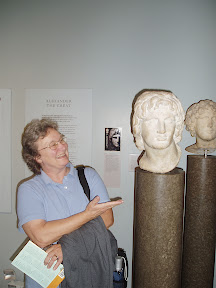
The most satisfying display in the museum was the Elgin or Parthenon marbles. The entry to the display included information about how the marbles came to Britain and the controversy about their continued presence in London. The marbles themselves were arranged around a rectangular room in the way they would have appeared on the building.

After viewing just a portion of the museum it struck me that the museum is in search of a mission. It could be an Art museum and focus on the artifacts as works of art from different eras and places around the world. Or, it could focus on Britain – its history as an island, its age of Empire, its relationships with other nations and empires. The Age of Enlightenment room seems headed in the direction. It could also focus on great ideas – the current display on Living and Dying is an example of this direction. The renovation of the early Britain room may give us a signal about the direction the museum plans to go in the future.

As a side note- for those who want to see a great preview of the British Museum, check out this article from Wikipedia.

London Calling and the Mother & Child Reunion

October 1st thru October 7th 2006

Sunday October 1st, 2006, both my mother and I arrived in London . She had flown out the night before out of Minnesota and had arrived earlier in the day. I left Sogn around 2:00 PM and caught the T-Bane to Oslo Central Station and onward to a Flytoget to get to the airport. My flight was scheduled to leave at 6:25 PM and I was to arrive at Stansted Airport outside of London at 7:30 PM (1 hour time difference).

I was glad that I arrived early considering the queue at the Oslo Airport was quite long, however, I eventually made it to my correct gate and eventually my flight took off after about a half-hour of waiting, followed by a short bus ride to our plane and a quick walk from the bus and right onto the plane. A part of me felt like a celebrity, however, I realized then how cold it really was outside and wasn’t too happy about walking out to the plane vs. walking down a gantry.

I landed at Stansted at 8:00 PM, collected my luggage, and then made my way to catch a train from the Stansted Express line to Liverpool station and onward to Marble Arch station near Hyde Park home to the Parkwood Hotel , our base of operations for the 5 days in London. The trains had other plans. That evening, the Stansted Express train was canceled between the airport and Liverpool Street Station for “Engineering Improvements”, where I needed to go. So instead of taking a train, I bought a ticket with a bus line called National Express and bought a ticket to Marble Arch in London.

I and what felt like hundreds of others, had to buy bus tickets as well, and spent a long time standing in the cold with all of our luggage waiting for the next available bus to wherever in London we needed to go. After about a half-hour I hoped on a bus that would take me to Victoria and Marble Arch. Riding on the bus for close to an hour it put me near Marble Arch around 11:00 PM, meaning that it took me close to 3 hours just to get from the airport to even the vicinity of the hotel. However, the fun didn’t stop there. Eventually I found the hotel simply by wandering and asking for help and it turns out I was rather close, but since it was a Sunday night the reception desk was closed and I had to ring the night bell once I found the place. Funny thing is, that my Mom heard my suitcase rolling down the street and my conversation with the night manager and greeted me as I came in.

Monday we woke up just in time for breakfast consisting of many cups of coffee, scrambled eggs, bacon, and sausage very British and very satisfying. We decided that for Monday our goal would be to tackle the overwhelming British Museum and then to see how we felt after that. My Mom has written an analysis of the museum which is not entirely a representation of Britain nor a museum but instead a display of the spoils from conquered countries from Colonialism that were once colonies of the vast British Empire. Most of these artifacts were stolen, bought, or acquired by other means. For example, the recent controversy over the Greek Statues from the Parthenon that are currently on display in the British Museum. I will post my Mother’s analysis after this one.

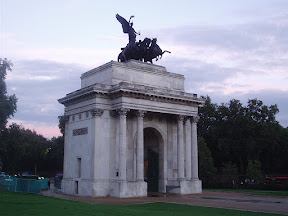
After the museum we ate at a local pub and had Fish and Chips and a brew. We also talked to a local Brit who had recently been to Minnesota visiting a friend, he recommend some activities for the rest of our stay. After lunch/dinner it started to rain, so we headed back to the hotel to grab a nap and talk about the British Museum. Later, we walked from the hotel along Hyde Park to Buckingham Palace and Queen Victoria’s Monument.

From 5 Days in the...


From 5 Days in the...


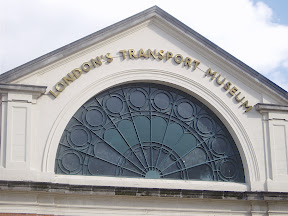
Tuesday, we had a very early start, waking up at 7:30 AM, and enjoying a good breakfast before heading out for another day of adventure. Our destination was the London Eye followed by a trip to Trafalgar Square home of the National Gallery, which we toured for a long time and got pretty burned out. After a coffee from the café at the square, we walked to Covent Garden to see the London Transport Museum, however, the museum is currently closed until 2007. You can read more about the Museum here:

Trafalger Square London
Trafalger Square
Post Card London
Post Card London

Disappointed over the closure of the museum, we stopped at the souvenir shop for the museum and picked up a few things including a Mind The Gap T-shirt for myself (which I wore today to class). However, I am a little worried that I should have gotten a XXL rather than a single XL considering how tight it felt when I put it on today :(

In regards to Public Transport, I was very impressed by the London Underground and glad to have the opportunity to ride and analyze the system. More on that in a later post that I will write hopefully soon.


From 5 Days in the...

The London Transport Museum

With still some strength in us, we made the trip from Covent Garden to the next tourist trap: The Tower of London. This contained most of the historical items we were hoping to see at the British Museum…Weapons from Medieval times including the collection of Henry the VIII’s armor, other royal armaments, and vast amounts of all kinds of instruments of combat. As one of the guides described to us “This was a fortress and a place of war, and still is today”, which is true, soldiers of the British Military still reside in the Tower of London as well as the Yeomen Wards who give great tours. Oh, as a side note the Crown Jewels are there as well!!!

We were both very impressed on how the Tower of London was laid out though in where we started and then where we ended, unlike the British Museum where you could start anywhere much to our frustration.

Completely wore out from our travels of the day, we hopped on the “Tube” back to Marble Arch and grabbed dinner at a Lebanese Restaurant and had a wonderful meal before relaxing and reflecting in the hotel before heading to bed ready to tackle the next day.

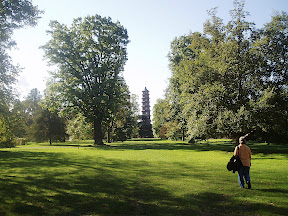
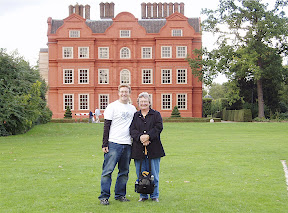
Wednesday, we woke up early again and enjoyed the full English breakfast routine provided by the hotel staff, which btw was very odd how they played techno or pop radio instead of the news in the morning, but oh well. The big breakfast paid off, because Wednesday was one of our longest in London. We spent a majority of the day (4 hours) at Kew Gardens also known as the Royal Botanical Gardens Kew meandering through the gardens, admiring trees, walking up Pagodas, watching old ladies being harassed by birds, and enjoying the gardens on a beautiful fall sunny day. Kew Gardens was probably one of the best places that we visited and definitely a stop I would make again.

From 5 Days in the...


From 5 Days in the...


After seeing Kew Gardens we enjoyed Burgers and a pint of beer at this restaurant outside of the Kew Station, which was really satisfying after four hours of walking around. When we got home we both took a very long nap and thought about the rest of the night. When I had landed, I met this older British Woman who helped me get to the hotel but also recommended a great and cheap Chinese restaurant called Wan Ku (I think), so we ventured to Soho and China Town looking for this restaurant and instead found Lee Ho Fook’s from Warren Zevon’s Werewolves of London. We had to grab something to eat from there, however, we didn’t have a camera.

It started to get pretty crazy around that area of town when we started to leave and I think there were delays on the underground, so we were ready to head home and call it a night.

Thursday morning, we again had the full English breakfast and hiked to Leicester’s Square and searched for discount tickets to a show. We decided on Guys and Dolls staring Patrick Swayze for Thursday evening. Having got the tickets we took the underground to Lambeth North Station and then walked to the Imperial War Museum. This was an amazing museum with the main focus of war, mostly on Britain in World War I and World War II. One of the best pieces of the Museum was a section of the World War I and a recreation of what life would have been like battling in the Trenches that made World War I the war that the world would never forget. Another good recreation section was the blitz on London; however, it did not deliver or was as well thought out compared to the Trenches piece. The museum also possessed a great amount of military hardware including tanks from both WWI and WWII of both the Allied and Axis forces, artillery batteries, aircraft, and a very large inventory of things from all sectors of the world wars. Lastly, we walked through the Holocaust exhibit and then the exhibit on continued conflicts since the end of World War II.

After the museum, we grabbed some dinner at Navajo Joes’s, a restaurant recommended by Karena Johnson, who had worked in London over the summer. The food was pretty good and afterwards we walked to Piccadilly Circus and were able to eventually find the Piccadilly Theater where the performance was held. However, when we arrived, we found out that Patrick Swayze would not be performing that evening as a result of an injury. We were a little disappointed but still where excited to see a musical in London, especially a musical neither of us had seen. The play was great, however, we didn’t know who Patrick Swayze’s character was supposed to be so we quickly checked the website (which I have linked) when we got home and he was supposed to play the character Nick Detroit. What was funny was that we though that the person who played that character the night we saw the performance was perfect! Oh well.

Friday was another busy day of running around for our last full day in London. We started at the London Museum, which chronicled London as an ever-changing area of human civilization all the way from ancient times to Modern times, and the challenges that London needed to face to become the Metropolis of 7 Million people that it is today. Probably another one of the places that was of high interest to me (being an Urban Studies Major) and a museum I’d like to tour again.

The rest of the day was spent touring two famous churches St. Paul’s Cathedral and the Temple Church of the Knight’s Templar. At St. Paul’s we climbed a lot of stairs to the top of the dome and I went even farther up to the stone gallery on the outside of the church but was greeted by the heavy London rain. After that, we descended down into one of the largest underground crypts in Europe and saw some famous tombs. The Temple Church we had to see since being fans of the great book The Da Vinci Code that now more than half the world has read and seen as a major motion picture. Lastly, we visited the National Portrait Gallery and then called it a day.

For dinner, we enjoyed some delicious Italian food, however, the service was the slowest I have experienced so far in Europe. That night, I packed and went to bed early.

Saturday morning I was up at 5:30 AM, and out the door to catch a train to Liverpool Street Station and back to the Airport to get back to Oslo. Thus ended the semester break and the much-needed visit with my mom.

After this post, I plan on posting my Mom's review of the British Museum (as stated above) and then hopefully later on in the week writing a summary of some of the big events that have taken place here in Oslo over the course of the program.

Stay tuned for more updates from Oslo

Cheers!

Sunday, September 24, 2006

Nigard Glacier vid

This is from my second Hiking in Norway trip, through the University of Oslo special Events for international students. We spent a weekend in Fjaerland hiking 1000 meter hills and walking on the Nigard Glacier.

Enjoy the movie, it is one of my personal favorites:


More updates soon to come, just got back from Denmark, and still need to post the details of the Bergen/Stavanger trip, prepare for the trip to London with the Mom (next weekend already), fill out postcards and mail them, as well as continue to read and study.

So much to do and so little time,

Andrew

Tuesday, September 12, 2006

Bergen and Stavanger

September 8th-11th 2006

This was our SUST groups’ first trip together on our own in Norway. We spent for days on the west coast of Norway, 2 days in Bergen and 2 days in Stavanger. Our Professor had given us the day off on Monday the 11th, and so we had plenty of time to plan.

Andrea cooked up a great and pretty affordable itinerary for us all to follow that got us to Bergen by train from Oslo, then flying to Stavanger and later to Oslo. Aviation will be discussed later in the blog.

Late Thursday evening, I got my backpack filled to the brim with clothes for the four-day trip along with some toiletries and spent the night looking through my lonely planet guide unable to sleep. I think I might have gotten an hour of sleep at the most, because I was up at around 4:30 AM taking care of last minute packing and eating some kind of breakfast before heading to Ulleval Stadion to catch the T-Bane to Oslo Central Station. Our train was scheduled to leave at 6:20 in the morning, meaning that we needed to catch the first T-Bane out of Ulleval.

It was cool to see Ulleval all light up in the early hours of the morning, and seeing the moon above Sogn was quite a sight. Suffice to say, I made it to Ulleval pretty early and waited for the T-Bane for a good half hour. While waiting, Maria and Jennifer arrived with their stuff and waited as well. They were able to get some sleep the night before, but weren’t up for much conversation. Around 5:45 AM, the T-Bane finally arrived and Heather came bolting down the steps to the station and got on just before the doors closed. I was impressed that she was able to make it, however, she had some trouble catching her breath afterwards but then so would I if I had to run down a flight of stairs with a huge pack in an attempt to catch a train.

We arrived at Oslo Central Station and identified our platform where our Train was waiting patiently for us.

From the platform, we identified our couch and seat numbers and proceeded to get settled and wait for Mark and Andrea that didn’t catch the first T-Bane. We got a frantic call from Andrea once we got in the train, saying they were on their way and concerned about their passports. We told them not to worry and they shortly arrived.

Mark had to call a flat mate of Andrea’s to find out his seat and confirmation number after forgetting to print them off earlier. Although it may seem early in this story that it was Mark and Andrea who were the ones who were left behind, it gets better (or should I say worse) for our author in the coming paragraphs.

Suffice to say, the train left without a hitch and with all of us present and accounted for. The others for the most part slept or listened to their Ipods, while I was wide awake and glued to the window, watching us being passed by other trains coming in and out of Oslo Central Station, and the changing scenery as we left Oslo and moved out along the Oslo-Bergen Railway named one of the most Scenic routs by National Geographic in 2004.
View 2
While the ride was very scenic and smooth (not too many bumps), the train or tog still took 6 hours. The delay was due in part because most of this line is single track in many stretches through the mountains, and trains must yield to other trains based upon who gets to use the ROW first. However, there is a German company that has plans of upgrading certain routes such as the Oslo-Bergen railway to “high-speed” rail standards and adding double track in certain parts to cut the overall trip from 6 hours, to 1-2 ½ hours. This is to increase competitiveness of the Norwegian Railways to compete with the Air Industry in Scandinavia. For those interested check it out: Norsk Bane

We got to Bergen Friday afternoon around 2:30 and were greeted with typical Bergen Weather, which is nothing but rain. We quickly found our hostel, Jacobs Apartments, centrally located in Bergen and highly recommended by the Lonely Planet Guide and other people who we had talked to before we left, and did the entire process of checking and getting settled before taking off for high adventure.

After we checked in, we all realized we were really hungry and headed to the Fish Market in the pouring rain for some food. All of us settled on fish and chips, freshly caught Cod covered in batter and then fried along with some French fries, and was my first time having fish in Norway. Wasn’t that bad, had a clean plate at the end, and was satisfied for the remainder of the day.

Because of the rain, Andrea got upset that her shoes were getting wet and so we set off on search for a pair of rain boots for Andrea. We walked to like 5-6 shoe stores all before they closed. Thankfully she was able to find a pair that was her size and a color that was a pretty snazzy red. With Andrea’s new boots taken care of and everything right with the world we started looking into nightlife. Suffice to say, I was ill prepared for nightlife with not packing my contacts and stuck with the glasses. We ended up going to this nightclub/bar that ended up later in the night turning into a crazy rave. Not that there is anything wrong with raves or dancing, but when you add drinks in glasses and then bodies moving to music, the result is not only drinks poured on other people but glasses being dropped and shattered all over the dance floor. While waiting to head out, I saw a guy come running down a set of stairs with blood running down his arm, I assume he had fallen on the floor and got cut up pretty bad.

Saturday morning, the weather cleared and stayed warm and sunny for the rest of the entire weekend. We capitalized on the nice weather and took the Bergen Floibaner or funicular to the top of the hill, and got some good pictures of Sentrum Bergen and some good group shots.
Post Card Bergen:Forgive the quality of the photo, I think there was some condensation on my lens from the day before.
Post card Bergen...


SUST group minus 1 on the Funicular

From the top of the hill, we had a great hike back down, not too tough considering there was a gravel path and made our way back down to the city center. I split off on my own to check out a tower and former guard post of Bergen, hoping to climb to the top and get some sweet pictures, unfortunately they had closed about a half hour before I got there. However, I did see some kids mock fighting in full medieval battle gear (swords, axes, and shields) that provided some entertainment. From there, I wondered back to the main tourist drag near the fish market, found a place selling Pancakes for 10 Kroner and got one fresh off the pan vs. cooling on the plate, and then bought some postcards focusing on Bergen (that yesterday September 27th, I finally mailed).

Saturday night we ran into some German friends of ours from Sogn, who had drove from Oslo to Bergen for the weekend. We made plans to hang out later, and that night I became an honorary German through a couple of rounds of “Circle of Death” or “Kings”, from which we embarked to a crazy bar called….can’t remember the name but they had Guinness (which I love) and turned out to be a metal bar with tiny Norwegian girls with really really deep scary voices performing in the basement (lol). Suffice to say we didn’t stick around long considering in the morning we needed to be at the airport to catch a flight from Bergen to Stavanger and the next two days of our trip. I set my alarm for 7:45 AM and hoped I would wake up.

Sunday morning I woke up on time, and thought I had enough time to get to the airport considering my flight wasn’t until 9:20. However, to get to the airport I either needed to take a bus or a taxi. I checked out of the hostel by dropping off my keys and walked to the bus Terminal looking for the Flybussen. However, by the time I had gotten to the bus terminal the Bus had already left and wasn’t coming again until 9:00!!! Immediately I thought, what am I going to do? The flight is scheduled to leave at 9:20, how fast can this bus get me to the airport, is there a taxi? Not having a mobile phone or answers to any of these questions nor a taxi in proximity, I decided to take my chances with the Bus. What else could I do?

I got to the airport 5 MINUTES late, no baggage to be checked just needed to get on the plane and ran to the gate, tried to get through security as fast as I could, and the plane was already gone. My hope was this would be like a US airport where the plane doesn’t leave for another 10 minutes, boy was I wrong. Later I found out that my friends had gotten on the plane because they had taken a taxi and were expecting me to come running on the plane or running out to the runway, and no matter how much I wish that could have happen it didn’t.

I think I am cursed when it comes to air travel considering that the day I was traveling was the 10th, 1 month after my first chaos with planes and Norway. Suffice to say, I ended up being 2 hours behind my friends and had to book another flight with a different airline and then sit and wait for a 40 minute + flight. Flustered but enduring I pressed on and made it to Stavanger and through the use of the lonely planet guide found the ferry that would take me to Tau and onwards to Preikestolen of the Lysefjorden.

When I made it to the ferry I called Tim, my program director, who gave me the mobile numbers of a member of my group who I frantically called and caught up with. The first thing they said was “How r u, and more importantly where are u??” I explained that I had made it to Stavanger and would meet them in Tau.

When I got off the Ferry, there they all were as promised and I was never so happy to see them all. We hopped on the bus and took it to the hostel at the start of the hike to Preikestolen. We took care of checking in and then HIKED THE MOUNTAIN. Now, this wouldn’t have been a problem, but I had run out of cliff bars about a week earlier and hadn’t had anything to eat since arriving in Stavanger. But the weather was nice, and we were uncertain to the amount of time we would have on Monday, and so we hiked the path to Preikestolen, 2 hours up and 2 hours down.

Pulpit Rock/Preikestolen Stavangre Norway

And wouldn’t you know it, my camera decides to die right when we make it to the end of the hike, not die as in permanently dead, but the battery quite out on me because I didn’t bring a charger. The view from atop Preikestolen (604 Meters above the Fjord) was probably one of the coolest things I have experienced so far, and it is my hope that I can come back with Kristen or my brother and share the experience of the hike with others.

The shot (shown above) was taken by me using Mark’s camera, which he generously let me use for a few shots. When we reached the bottom, Mark and I got some food, enjoying a cauliflower soup with broiled Salmon and bread for about 70 Kroner which was one of the best meals I had enjoyed since my arrival.

All tired and fed, we relaxed by chatting and drinking tea and ever so often wondering outside into the cold air to look at the stars (which were not to be seen, too overcast) and reflect on the days events, particularly of the follies of the first time traveler, Me! I think the night after the hike, may have been the hardest I have slept in a long time, and I can assure you that my legs were trembling when I came down the mountain, and not too happy with me the next morning.

Monday we left Preikestolen, after a huge Norwegian breakfast and headed back to Stavanger. The plan was to dink around town before our scheduled flights. Most of the others went shopping and did some exploring, I did some of that myself and ate lunch at this neat Greek Restaurant, and then to pass the time went to the Norwegian Petroleum Museum to then take the Flybussen back to the airport. Little did I know that fate was against me again.

Turns out I had booked my flight for the morning instead of the evening, not taking into account military time, and ended up having to buy a ticket on the last flight to Oslo that evening which was delayed several times. By the end of the weekend, I didn’t want to step foot on another god damn plane. Suffice to say I landed in Oslo around 8:30 (Maybe) then got set to take the Flytoget (Airport Express Train) back to Oslo Central Station, costing me 160 Kroner then finding out afterwards that there was a student rate, but too late, and then getting off at the wrong station. When I figured this out, I quickly jumped on board the next regional NSB tog (or train) and grabbed a seat and sat nervously waiting for Oslo S to be the next station. I began to see people move towards the front of the train, and then out of the corner of my eye I turned and saw a ticket inspector coming my way. Not having a valid ticket for the regional NSB tog, I grabbed all my things and walked as fast as I could to the front where the other people were gathering, and as soon as the doors opened I was gone like the wind making my way to the T-Bane.

So that sums up my weekend in Bergen and Stavanger, been really tough to write all of this down, but hopefully I can post it later tonight and add in the photos I want from the flickr pages to make it better.

Stay tuned for new videos (maybe) and summaries of other trips in the land of the midnight sun that is Norway.

Until next time,
Andrew